

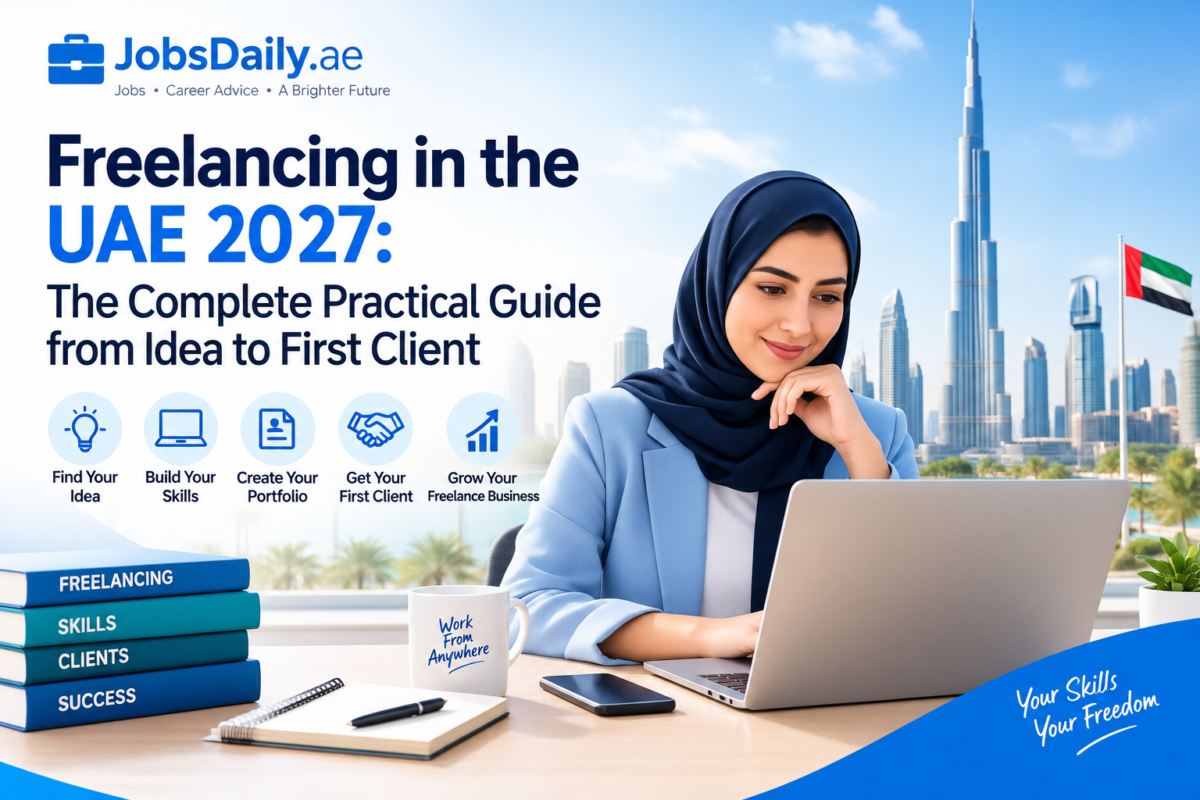

Freelancing in the UAE (1) has changed dramatically in recent years, and a career no longer has to end with signing a contract with a single employer. Freelancing in the UAE (2) specifically has shifted from a fringe option into a serious career path backed by clear government support through specialized licenses, visas designed specifically for freelancers, and free zones that streamline the legal process like never before.
But despite all this support, many aspiring freelancers still get stuck at the “idea” stage, never quite figuring out how to turn it into real, legal income. In this guide from Jobs Daily, we’ll walk you through Freelancing in the UAE (3) step by step — from understanding the legal framework to landing your first real client.
Freelancing vs. Entrepreneurship in the UAE Context
Before diving into Freelancing in the UAE (4), it’s worth clarifying two concepts that often get mixed up:
Freelancing: Offering your personal services (writing, design, consulting, programming, etc.) to multiple clients for pay, without setting up a full company with employees and a complex operational structure.
Entrepreneurship: Building a full-fledged business entity usually with employees and a scalable product or service which requires a complete commercial license, not just a freelance permit.
This guide focuses specifically on Freelancing in the UAE (5) as a path, which is the better fit for most people looking for professional independence without the complications of setting up a full company.
The Legal Framework: How to Work Officially and Legitimately
Doing Freelancing in the UAE (6) “off the books” meaning offering paid services without an official license exposes you to real legal risk, including fines. Fortunately, several authorities offer licenses tailored specifically for freelancers, with relatively simple procedures:
1. Freelance licenses from specialized free zones
Several UAE free zones offer dedicated “Freelancer Permits,” most notably:
- Dubai Media City and Dubai International Production Zone (formerly twofour54 in Abu Dhabi): geared toward people working in media, design, content creation, and digital marketing.
- Sharjah Media City (Shams): one of the most popular options, thanks to its competitive cost compared to Dubai.
- Dubai World Trade Centre (DWTC): offers freelance licenses across a wide range of fields beyond media, including consulting and training.
- RAKEZ in Ras Al Khaimah: a popular budget-friendly choice for digital and consulting professionals.
2. The Freelance Visa
Once you have your license, you can apply for a residency visa tied to it no need for a traditional sponsor (employer) giving you full flexibility to work with multiple clients at once.
3. Tax registration, if applicable
If your annual revenue crosses the mandatory VAT registration threshold (set by the Federal Tax Authority), registration becomes obligatory, and you’ll need to issue tax-compliant invoices in line with local regulations to avoid penalties.
The Real Cost of Starting a Freelance Business: What No One Tells You
Most articles about Freelancing in the UAE (7) stop at mentioning the “licensing fee” and ignore the full picture. Here’s a more realistic breakdown of what you should actually budget for:
- License issuance fees: vary significantly between free zones, and depend on how many activities are permitted under a single license.
- Visa, medical test, and Emirates ID fees: a completely separate line item from the license fee, often overlooked in initial planning.
- Mandatory health insurance: legally required for residency holders, with cost varying by coverage level.
- “Virtual address” or shared workspace costs: some licenses require a business address, which the free zone may provide itself or may require a separate coworking space subscription.
- Annual renewal fees: usually lower than the initial issuance fee, but still a fixed yearly obligation that should factor into what you charge clients.
Practical tip: don’t price your services based on “desired income” alone first calculate your fixed annual costs, and build them into your pricing from day one.

Choosing the Right Field: What Does the UAE Market Actually Want?
Not all skills see equal demand in the local Freelancing in the UAE (8) market. Fields that consistently see strong demand from both companies and individuals include:
- Digital content creation and social media management: driven by small and medium businesses increasingly relying on digital marketing instead of big agencies.
- Graphic design and UI/UX design: steady demand from startups without in-house design teams.
- Specialized writing and translation: especially bilingual (Arabic-English) content for companies operating in the regional market.
- Management and financial consulting for small businesses: many startups prefer contracting an independent consultant over hiring a full-time employee in their early stages.
- Photography and video for marketing content: fueled by growth in the real estate and hospitality sectors, which rely heavily on visual content.
- Part-time software and web development: for small companies that don’t need a full-time developer.
How to Land Your First Client in 30 Days: A Practical Plan
The most common mistake people starting Freelancing in the UAE (9) make is waiting for everything to be perfect the website, the branding, the full license before starting to market themselves. Here’s a more realistic plan:
Week 1: Build a simple visual foundation
You don’t need a complicated website to start; a single page clearly explaining your services (using free tools) is enough to launch. Instead, spend your time putting together 3-5 portfolio samples that show your quality level, even if they’re volunteer or training projects.
Week 2: Targeted direct outreach
Rather than waiting for clients to come to you, reach out directly to 20-30 small or medium businesses that fit your field, with a short, personalized message (not a generic copy-paste) explaining how you can solve a specific problem they have.
Week 3: Tap into your existing network
Announce your new venture clearly and directly within your professional circles (former colleagues, contacts, professional groups) personal referrals are often the fastest route to a first paying client, faster than cold marketing alone.
Week 4: Offer a “low-risk starter” deal
For hesitant clients, propose a small trial project at a token price or limited scope, instead of asking for full commitment upfront. This lowers the client’s hesitation and gives you a chance to prove your quality before negotiating bigger projects.
Pricing: How to Set Your Rate as a New Freelancer Without Underselling Yourself
One of the biggest mistakes people new to Freelancing in the UAE (10) make is pricing based on “what I can afford to charge” instead of “the actual value of the service.” To avoid that:
- Calculate your real hourly rate first: divide your target monthly income by the number of hours you can actually bill (not your total working hours, since part of your time goes to marketing and admin).
- Benchmark against the local market, not just the global one: rates on global freelance platforms often don’t reflect Freelancing in the UAE (11) market standards, which tend to value quality and professionalism at relatively higher prices.
- Offer packages instead of pure hourly pricing: many local clients prefer paying a fixed amount for a clear outcome (like a “monthly social media management package”) rather than being billed hourly, since it gives them more clarity for financial planning.
Managing Client Relationships: Simple Contracts That Protect You Legally
Even if the client is a personal contact or a trusted referral, don’t skip putting the agreement in writing. A simple one-page contract covering: precise scope of work, timeline, payment terms (typically a 30-50% upfront deposit), and a policy on additional revisions, protects you from disputes down the line that can be costly both financially and emotionally.
The Real Challenges of Freelancing in the UAE
In the interest of not painting an overly rosy picture, Freelancing in the UAE (12) comes with real challenges you should be prepared for:
- Irregular income: especially in the first few months, which calls for savings covering 3-6 months of basic expenses before fully transitioning away from a stable job.
- No traditional benefits: such as employer-sponsored health insurance or an end-of-service gratuity, meaning you need to plan for these on your own.
- The need for strict self-discipline: without a traditional work structure, you need strong personal discipline to stay productive.
- Seasonal demand fluctuations: some fields (like photography and events) see clear seasonal swings, making income diversification important.
Conclusion: Freelancing Is a Serious Path, Not a Temporary Fix
Freelancing in the UAE (13) has become a mature career path, backed by a clear legal framework but it needs to be treated with the seriousness of a real business, not a random side gig. Success in Freelancing in the UAE (14) depends not just on technical skill, but on understanding the legal framework, pricing smartly, and building trustworthy professional relationships that gradually turn into a stable, growing source of income.
Common Mistakes New Freelancers Make in the UAE
- Starting without a license “just to test the market.” Even a few months of unlicensed paid work carries real fine risk if discovered.
- Forgetting the renewal cost when pricing. A license that felt affordable in year one becomes a recurring cost that many freelancers forget to build into their rates.
- Skipping health insurance until visa stamping forces it. This is mandatory, not optional, and delays cost time and money.
- No written scope of work, even with friends-of-friends clients verbal agreements are the single biggest source of freelance payment disputes.
- Pricing off global freelance platforms instead of local UAE market rates, which tend to run higher for quality work.
Frequently Asked Questions
Can I freelance in the UAE without a license?
No offering paid services without a freelance permit is not compliant with UAE regulations and can result in fines.
Do I need a UAE company to freelance, or can I use my home country’s business?
You need a UAE issued freelance permit (from a free zone or eligible authority) to legally invoice UAE clients and, if you need residency, a freelance visa tied to that permit.
How long does it take to get a freelance permit?
Processing time varies by free zone and activity, but many freelance permits can be issued within days to a few weeks once documents are submitted correctly.
Can I sponsor my family on a freelance visa?
In several free zones, yes a freelance permit holder can typically apply to sponsor dependents, subject to income and documentation requirements set by that authority.
Is VAT registration mandatory for freelancers?
Only once your taxable turnover crosses the mandatory threshold set by the Federal Tax Authority; below that, registration may be optional or not required.
Discover how freelancing in the UAE has changed. Learn here how to launch your freelance career and find new opportunities today.
Here’s a set of official sources and links issued by UAE government authorities regarding freelance work laws and permits:
Official Portal of the United Arab Emirates Government
Ministry of Human Resources and Emiratisation (MOHRE)
“GoFreelance” Platform – Dubai Development Authority (TECOM / Dubai Internet City)
Abu Dhabi Department of Economic Development (ADDED)
Ras Al Khaimah Economic Zone (RAKEZ)
Table of Contents

“The Jobs Daily editorial team is dedicated to tracking and publishing the latest verified job opportunities across the United Arab Emirates. We assist job seekers by providing career guides and resume optimization strategies designed to pass Applicant Tracking Systems (ATS).”