


In many companies, the weekly meeting opens with the same question: what happened last week? Someone puts the numbers on screen, and the room debates why sales dipped, why costs crept up, or why a shipment arrived late. Then a decision is made to fix a problem that has already happened. It works, but it keeps management one step behind reality.
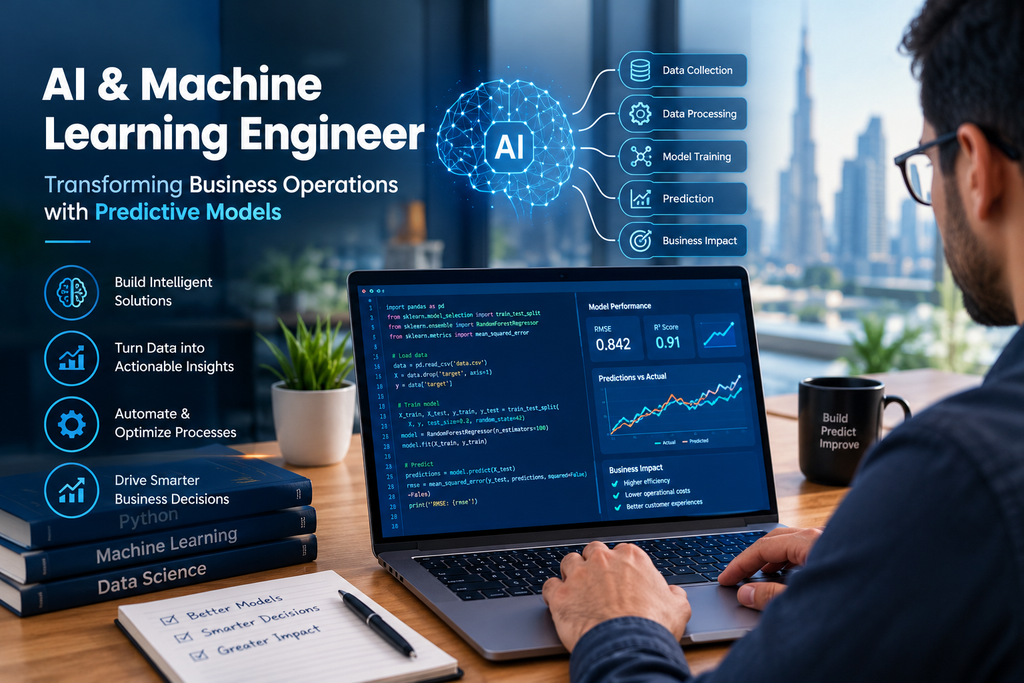
This is where an AI & Machine Learning Engineer | Transforming Business Operations with Predictive Models changes the picture. Instead of explaining the past, this professional builds systems that estimate what is likely to happen next. The question shifts from “what went wrong?” to “what do we expect next month, and what should we do now to be ready?”
In this guide, we explain what this role involves, how predictive models are built inside real organizations, where they create measurable value, and which mistakes sink projects before they start. If you are a business owner, a manager, or someone considering this career, you should come away with a clear, practical picture.
What Does an AI and Machine Learning Engineer Actually Do?
Some people imagine a researcher buried in complex equations. Others imagine a programmer who presses one button and out come perfect forecasts. The truth sits between the two.
An AI and machine learning engineer turns a vague business problem into a software system that learns from data and runs reliably in a company’s daily operations. The work rests on three pillars:
- Business understanding: knowing why the company needs a prediction and which decision will change because of it.
- Data science: choosing suitable algorithms, preparing data, and evaluating results rigorously.
- Software engineering: moving a model out of a notebook and into a service that runs around the clock, is monitored, and gets updated.
The third pillar is what separates an engineer from a traditional data scientist. A model that scores brilliantly on a developer’s laptop is worthless if it never reaches the person making the decision, at the right moment, in a form they can understand. Google’s engineers make the same point in their well-known guide, Rules of Machine Learning: most of the problems you will face are engineering problems, and most of the gains come from good features rather than clever algorithms.
What Is a Predictive Model, in Plain Language?
A predictive model is a program that learns from past examples to estimate a future outcome. Picture a sales veteran with twenty years of experience. They can sense which customer is about to leave or which product is about to take off, because they have seen thousands of similar cases. A predictive model does the same thing with data, except it reviews millions of records at once, never gets tired, and never forgets.
Common types of prediction in business include:
- Classification: Will this customer default on payment? Yes or no.
- Numeric estimation: How many units of this product will we sell next month?
- Time-series forecasting: How will demand shift across seasons and holidays?
- Anomaly detection: Does this financial transaction fall outside the normal pattern?
One point deserves emphasis. A model gives probabilities, not certainties. If it says a customer has an 80% chance of leaving, that is not a promise. It is a signal that helps management decide where to spend limited attention.

The Project Journey: From Idea to Live System
Many projects fail because they start from the tool instead of the problem. The path a professional engineer follows looks like this.
1. Define the decision you want to improve
The engineer begins by asking the client: which decision do you want to make better? For example, which customers should we call this week? Or how much should we order from the supplier this month? The more specific the decision, the better the project. A request like “we want AI in our company” is not a starting point.
2. Audit the available data
Data is the raw material, and the first surprise is usually that it is messier than expected: missing values, duplicate records, systems that do not talk to each other, and departments that define the same term differently. This audit can consume half the project timeline, and it is time well spent.
3. Prepare the data and engineer features
This is where an engineer makes the difference. Features are the pieces of information the model relies on, and they often matter more than the algorithm itself. The number of times a customer contacted support in the last thirty days is a stronger signal than the date they signed up. Finding features like this takes conversations with the people who know the business, because they understand things the spreadsheets do not show.
4. Build and test the model
The engineer tries several approaches, from simple regression to random forests, gradient boosting, and sometimes neural networks. Libraries such as scikit-learn make it easy to compare options quickly. The golden rule is to start with the simplest model that could work and add complexity only when needed. A simple, transparent model often beats a sophisticated one that nobody can explain.
5. Evaluate with business metrics
Overall accuracy alone can be misleading. Suppose only 2% of transactions are fraudulent. A model that labels everything “legitimate” scores 98% accuracy and catches no fraud at all. So the engineer uses metrics such as recall and precision, and ties them to real costs: how much does each false alarm cost, and how much does each missed case cost?
6. Deploy to production
The model is packaged as a service, connected to company systems, tested on live data, and rolled out gradually to a small team before wider release. Cloud providers publish useful playbooks for this stage, including Google Cloud’s guide to MLOps pipelines and continuous delivery for machine learning.
7. Monitor and update
The world changes. Customer behavior two years from now will not look like today’s. This effect is known as concept drift, and it makes a model lose accuracy quietly. A good engineer sets up monitoring dashboards and alerts, and retrains the model on a schedule.
Real-World Applications Changing Daily Operations
The value of an AI & Machine Learning Engineer | Transforming Business Operations with Predictive Models shows most clearly in everyday operations. Here are the areas where the impact is most tangible.
Inventory and supply chain management
Every warehouse manager knows the two losses: slow-moving stock that ties up cash, and stock-outs that lose sales. A model that combines historical sales, seasons, events, prices, and even weather can estimate demand for each product and branch. Costs fall without hurting availability.
Predictive maintenance
In factories and industrial facilities, an unexpected breakdown of a key machine can cost a fortune. Sensors measure vibration, temperature, and pressure, and the model learns the patterns that usually come before a failure. Instead of fixing machines after they break, or servicing them on a rigid calendar, the team receives an early warning and schedules maintenance at the best possible time.
Customer relationship management
Winning a new customer costs far more than keeping an existing one. A churn model spots the early signs of drifting away: falling usage, rising complaints, a delayed renewal. A dedicated team can then step in with a fitting offer or a thoughtful call before the customer decides to leave.
Finance and risk assessment
Banks and lenders use models to estimate default risk and to flag fraud in real time. The challenge is twofold: accuracy, and the ability to explain why an application was declined, because regulators and customers both expect a clear reason. Professionals who want to work in this area can browse banking jobs in the UAE to see how data skills are becoming part of finance roles, and our guide on finance jobs in Dubai with visa sponsorship explains how to approach that market.
Human resources
Models can estimate the likelihood of resignations in certain departments or forecast hiring needs during peak seasons. This area is sensitive and requires strict ethical safeguards, which we discuss below. HR teams interested in the field can explore human resources jobs to see how analytics skills are changing the profession.
Logistics and delivery
Accurate delivery-time estimates, better route planning, and early warnings about delays all improve the customer experience while cutting fuel and operating costs.
A Hypothetical Example: An Online Store Escapes Inventory Chaos
Consider a mid-sized online store selling home essentials. The purchasing manager relied on experience and manual spreadsheets, and the same problems kept returning: huge orders of a product whose demand was fading, and a popular item selling out at peak season.
The engineer began with a long session with the purchasing manager to understand how decisions were really made. Two things emerged. Sales in some categories were strongly seasonal, such as back-to-school and the start of summer. And ad campaigns affected demand two to three days later, not immediately.
After cleaning the data, the engineer built a model estimating weekly demand for each category. Features included campaign dates, prices, and moving sales averages. The model did not replace the purchasing manager. It gave them a dashboard showing the forecast along with a range of uncertainty, and left the final decision in their hands.
Over the following months, stock-outs fell and slow-moving inventory shrank. Just as important, the team came to trust the system because it was explained to them, and they kept the right to adjust its recommendations. (This example is illustrative and does not describe a specific company.)
Common Mistakes That Sink Projects
Starting with technology instead of the problem. Expensive platforms are bought before anyone knows what they will solve.
Ignoring data quality. Even the best model cannot rescue poor data. “Garbage in, garbage out” applies literally.
Data leakage. This happens when a model learns from information that will not be available at prediction time. Results look spectacular in testing, then collapse in the real world.
Leaving end users out. A system that employees do not trust gets ignored, no matter how accurate it is.
Inflated expectations. AI is not magic, and some problems simply do not contain enough signal to predict. Google’s guidance even lists, as its first rule, that you should not be afraid to launch a product without machine learning.
Neglecting monitoring after launch. A model is treated as a finished product, when in reality it needs ongoing care.

Ethics and Governance: A Responsibility as Important as Accuracy
Every model learns from human-generated data, and it can inherit the biases hidden in that data. If past hiring or lending decisions were biased against a group, a model trained on them may repeat and amplify that bias. A responsible engineer therefore commits to:
- Fairness testing: comparing model performance across different groups.
- Explainability: making the reason behind a decision available, especially in sensitive areas.
- Privacy protection: collecting only the data needed, anonymizing identities, and following applicable data protection rules.
- Human oversight: keeping a person in charge of the final call in high-stakes cases.
For a structured approach, the U.S. National Institute of Standards and Technology publishes the AI Risk Management Framework, a voluntary guide built around four functions: govern, map, measure, and manage. Trust is the real capital of any intelligent system, and it is built through transparency far more than through accuracy figures.
Skills Needed to Enter This Field
If you want to move into this career, the foundation looks like this:
- Programming: Python is the leading language, along with SQL for working with databases.
- Statistics and math: distributions, probability, bias, and variance.
- Machine learning libraries: such as scikit-learn, XGBoost, PyTorch, and TensorFlow.
- Data engineering: building reliable data-processing pipelines.
- MLOps: deployment, monitoring, and version management.
- Communication: explaining a complex idea to a non-technical manager in plain language.
In my view, that last skill is the rarest and the most valuable. An engineer who can clearly explain why the model predicts a certain number wins management’s trust far faster than a more accurate colleague who cannot.
For anyone planning a career move, the IT and technology job listings on Jobs Daily are a useful way to see which skills UAE employers are asking for right now. If you prefer flexibility, there are also remote positions, and you can narrow your search by city, for example jobs in Dubai or jobs in Abu Dhabi. For CV and interview guidance, browse the career advice section.

How to Measure Return on Investment
Management will rightly ask: is all this worth it? To answer, set a baseline before the project starts, such as the current stock-out rate, the customer churn percentage, or the average downtime. After deployment, compare performance against that baseline and express the impact in money or saved time.
The best projects start with one narrow use case that proves its value within a few months, then expand. A huge plan that takes years to deliver is a much riskier bet.
Future Trends
Organizations are moving toward more integrated systems: predictive models connected directly to decision tools, large language models that let managers question their data in plain language, and growing automation of routine model building. None of this removes the need for engineers. It changes the work, from writing repetitive code toward framing the right problems, assuring quality, monitoring impact, and managing risk.
Companies that need this talent can also reach it directly. Employers looking to hire data and AI professionals can post a job on Jobs Daily or browse the employers directory to see who is hiring in the region.
Conclusion
An AI & Machine Learning Engineer | Transforming Business Operations with Predictive Models stands where business, data, and software meet. Their value is not measured by how many algorithms they know, but by their ability to turn an everyday decision into a better-informed one. The companies that succeed in this shift start from a clear problem, respect their data, involve their teams, commit to ethics, and treat every model as a living system that needs continuous care.
If you run a business or manage a department, ask yourself one question: what is the most frequent and costly decision in my operation, and do I have enough data to improve it? The answer is your starting point.
Frequently Asked Questions
Do small businesses need machine learning?
Not always. Sometimes a simple spreadsheet analysis is enough. The need appears when you have accumulated plenty of data and face repeated decisions that could be improved.
How much data do I need to start a project?
There is no fixed number. Quality and relevance to the problem matter more than volume, and some projects succeed with only a few thousand records.
Will AI replace employees?
The clearest trend is that it changes the nature of tasks and boosts the productivity of people who use it well, while human judgment stays essential for important decisions.
How long does a typical predictive project take?
Often three to six months for a single use case, depending on data readiness and how complex the integration with existing systems is.
Table of Contents

“The Jobs Daily editorial team is dedicated to tracking and publishing the latest verified job opportunities across the United Arab Emirates. We assist job seekers by providing career guides and resume optimization strategies designed to pass Applicant Tracking Systems (ATS).”