

The Question Nobody Was Asking Ten Years Ago
When recommendation algorithms only suggested a movie or a song, nobody asked who was watching the algorithm. Today, intelligent systems help decide who gets a loan, who is invited to a job interview, how patients are triaged in emergency rooms, and what millions of people see in their feeds every day.
Once an algorithm moves from helpful tool to decision-maker, fairness, accountability and transparency become practical necessities. This is why the AI Ethics & Governance Specialist has become one of the most interesting and fastest-growing roles in the modern tech job market.
This guide covers what an AI Ethics & Governance Specialist does day to day, the frameworks they rely on, the skills you need, and how to start your own path. We also look at what the field means for the Arab world and the UAE.
Who Is an AI Ethics & Governance Specialist?
An AI Ethics & Governance Specialist helps an organization build and use artificial intelligence in ways that are responsible, lawful and trustworthy. They rarely write the models themselves, but they understand them well enough to ask the right questions of the people who do.
The role comes down to three verbs: ask, document, control.
- Ask: Does the training data represent all groups? Can we explain the system’s decision to a person it affected? What happens when the system gets it wrong?
- Document: Turn the answers into risk assessments, records and written policies that can be reviewed and audited.
- Control: Put procedures in place so that what is written on paper actually happens in practice.
The role differs from an AI engineer, who asks “How do we build this?”, and from a lawyer, who asks “Is this legal?” An AI governance specialist asks, “Should we build it this way at all, and how will we prove it is safe and fair?” That is why the job sits where technology, law, ethics and risk management meet.

Why Is This Role in Demand Right Now?
Four forces explain the growing demand.
1. Real-world failures. Several well-documented cases showed AI systems producing biased results. Résumé-screening tools learned from skewed historical data, and facial recognition systems performed unevenly across demographic groups. These failures cost companies money and reputation, and they taught executives that algorithmic error is a genuine business risk.
2. New regulation. The EU Artificial Intelligence Act is being phased in. It classifies AI systems by risk level and imposes strict obligations on high-risk uses. Companies outside Europe can be affected too if they serve European users, and other countries are moving in the same direction with their own approaches.
3. The spread of generative AI. Once employees began using chatbots daily, new questions appeared. What if someone pastes confidential customer data into an external tool? Who is responsible when a company publishes AI-generated content containing false information? These are governance questions.
4. Customer and investor trust. Clients now ask about responsible AI practices in tenders and due-diligence questionnaires. Organizations with documented answers win more trust.
What Does an AI Ethics & Governance Specialist Do Every Day?
You might picture endless philosophical debates. The reality is far more practical. Here are the core responsibilities.
1. Assessing Risk Before Launch
Before a product team releases an AI-powered feature, the specialist runs a structured assessment: what the system is for, who it affects, and what the worst plausible outcome is. A tool that suggests playlists needs far less scrutiny than one that influences hiring or credit decisions.
2. Reviewing Data
Most bias problems start with data. The specialist checks where it came from, whether it represents different groups fairly, what legal basis exists for collecting and using it, and whether proper consent was obtained. They work closely with legal and privacy teams on data protection.
3. Testing for Fairness and Robustness
Working with data scientists, the specialist measures how a model performs across different user groups. Do rejection rates differ between groups without a justified reason? What happens when the system receives strange inputs or manipulation attempts? Some of this testing is called red teaming, where a dedicated team tries to make the system fail so weaknesses are found before the public finds them.
4. Writing Policies and Guidelines
They write policies that non-technical people can follow. Which AI tools may employees use? What data must never be entered into them? When must a human review the system’s decision before it takes effect? A policy nobody understands is a policy nobody follows, so quality is measured by how easy it is to apply.
5. Documentation and Auditing
They keep records for every system: its purpose, data, test results and key decisions. When an internal or external review arrives, this documentation is the evidence that the organization acted responsibly.
6. Training and Awareness
They train engineers, marketers, managers and support teams, each according to their role. Many practitioners consider this the most important part of the job, because organizational culture decides what happens when nobody is watching.
7. Incident Response
When a user complains about an unfair decision or a researcher finds a flaw, the specialist leads the investigation, the fix and the communication, and makes sure lessons become permanent improvements.
Frameworks and Standards Every Specialist Should Know
Professionals do not work from a blank page. Several respected references guide the field:
- NIST AI Risk Management Framework: Published by the U.S. National Institute of Standards and Technology in 2023, it organizes risk management into four functions: Govern, Map, Measure and Manage. It is voluntary and flexible enough for organizations of any size.
- ISO/IEC 42001: The first international standard for an AI management system. Organizations can be certified against it, which is a real advantage in sensitive markets.
- OECD AI Principles: Among the first intergovernmental AI principles, centered on inclusiveness, transparency, robustness and accountability.
- UNESCO Recommendation on the Ethics of AI: A global instrument adopted in 2021 that emphasizes human rights, dignity and sustainability.
- The EU AI Act: Currently the most comprehensive AI legislation in the world.
A good specialist does not memorize these documents word for word. They know how to translate them into practices that fit their organization’s context and products.
Core Ethical Principles: From Slogans to Practice
Most frameworks share the same principles. Their value lies in how they are applied.
Fairness and non-discrimination. Saying “our system is fair” is not enough. You must measure outcomes across groups and choose a fairness metric suited to the case, because metrics can conflict and no single definition fits every context.
Transparency and explainability. People affected by an automated decision deserve to know an automated system was involved and to understand the main reasons in plain language. Some complex models are hard to explain, which raises a prior question: is this model appropriate for this use at all?
Privacy. Collect only the data you need, use it only for the stated purpose, protect it well, and give individuals rights to object and to correct it.
Accountability. Every system needs a named owner. It is the simplest principle and the most neglected. Responsibility shared by everyone often belongs to no one.
Human oversight. For high-stakes decisions, a qualified person must have the authority and the time to review and override the system. A rubber-stamp click is not oversight.
Safety and robustness. The system must perform reliably under expected and unexpected conditions and resist manipulation.

Skills You Need to Become an AI Ethics & Governance Specialist
This career blends skills from several worlds, and few people start with all of them. That is why professionals come from such varied backgrounds.
Technical skills (understanding, not engineering):
- Basics of machine learning and how models are trained and evaluated
- Types of bias in data and models
- Familiarity with cybersecurity and data privacy concepts
- The ability to read evaluation results and challenge them
Legal and regulatory skills:
- Data protection, intellectual property and liability
- Tracking new legislation and analyzing its impact on your organization
Management skills:
- Risk management, compliance and auditing
- Policy writing and project management
Human skills:
- Explaining complex issues to technical and non-technical audiences
- Negotiation: product teams will push for fast launches, and you must slow them down with arguments, not scare tactics
- Critical thinking and integrity under commercial pressure
- Cultural sensitivity, because what counts as “acceptable” differs between societies
One lesson comes up again and again in this field: a specialist who blocks work without offering practical alternatives quickly loses influence, while one who proposes solutions and makes compliance easier becomes a valued partner.

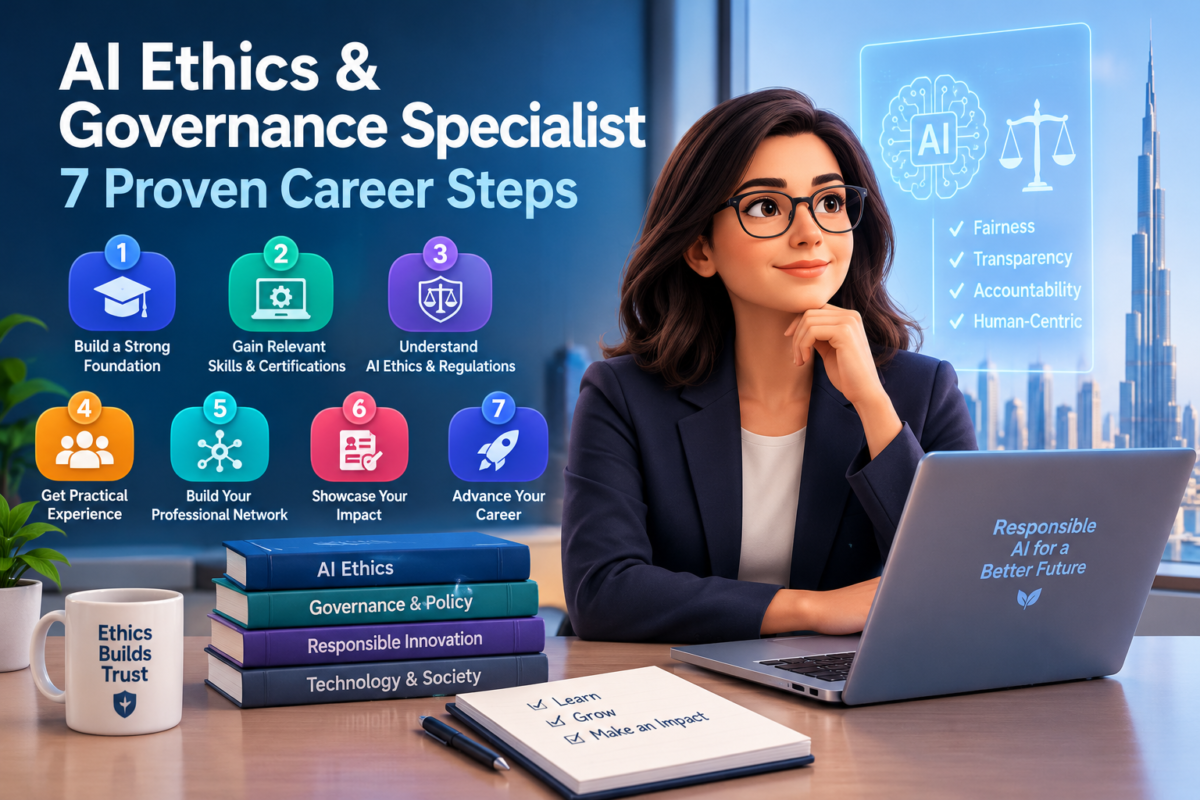
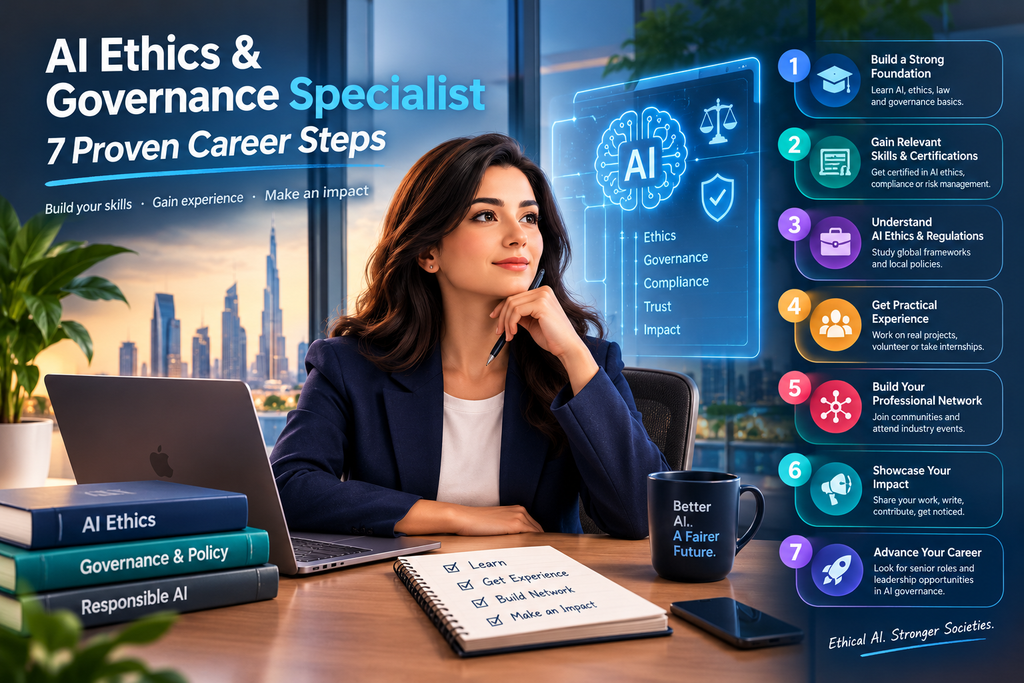
7 Proven Steps to Start Your Career
There is no single route, but these steps work for many people.
Step 1: Identify your starting point. If you are a developer or data analyst, you can build legal and ethical understanding. If you work in law or compliance, deepen your technical knowledge. If your background is in philosophy or social science, combine ethical analysis with practical risk management skills.
Step 2: Build a knowledge foundation. Read the frameworks above, starting with the NIST AI RMF because it is practical and free. Take courses on responsible AI and data governance from well-known universities and learning platforms.
Step 3: Practice on a real or imagined system. Pick a simple system, even a personal or hypothetical project, and run a full risk assessment. Identify stakeholders, write harm scenarios and propose controls. A portfolio of exercises like this often says more than certificates.
Step 4: Consider a specialist certification. Professional credentials exist in privacy and AI governance, such as the IAPP AI Governance Professional (AIGP), and in auditing against ISO standards. Check the issuing body’s credibility before you invest.
Step 5: Join the professional community. Follow researchers and practitioners, attend conferences, and take part in professional groups. The field changes quickly, and your network will be a main source of updates.
Step 6: Write and share your thinking. Analyze a real case, compare two frameworks, or critique a published policy. This shows structured thinking and gets noticed by employers.
Step 7: Apply strategically. Tailor your CV to highlight risk assessment, policy and compliance experience, and look at roles with titles such as AI governance analyst, responsible AI lead or AI compliance manager. You can browse current openings on JobsDaily.ae and check our guides on how to write a winning CV and in-demand tech jobs in the UAE.
Real Challenges of the Role
It is only fair to cover the difficult side.
Speed versus responsibility. Technical teams face launch deadlines and competition, and any extra step looks like a burden. Your success depends on building governance into the workflow rather than adding it as a final gate.
No ready-made answers. Many cases are gray. A system can be useful and risky at the same time, and you must weigh competing interests and make decisions you can defend.
Constant change. New technologies, new laws and new attack methods mean continuous learning is part of the job.
The “ethics-washing” trap. Some organizations publish impressive principles without real implementation. A good specialist makes sure ethics is measured by actions and outcomes, not press releases.
Limited authority. In some companies the role is advisory and cannot stop a project. When considering a job, ask where the role sits in the structure and what powers it has.
What About the Arab World and the UAE?
Several Arab countries have announced national AI strategies, created dedicated government bodies and issued ethical guidelines. The UAE National Strategy for Artificial Intelligence 2031 is one prominent example. This creates growing demand for AI Ethics & Governance Specialists in government, banking, telecommunications, healthcare and education.
The region also has specific needs that make local expertise valuable:
- Language: Many global models perform worse in Arabic and its dialects, which raises questions of fairness and representation.
- Cultural and value context: Algorithmic decisions must respect local values and norms, which only people who live in that context can judge well.
- Multi-jurisdiction regulation: Companies operating across several Arab countries deal with different data laws and need people who can coordinate between them.
For professionals who invest now, the opportunity is real. The field is still young in the region, and early movers become the reference points. To see how this fits into the wider job market, explore our latest jobs in the UAE.
The Future of the Profession
AI governance will likely shift from a specialist role to a general organizational capability, much as information security and compliance did over past decades. Cybersecurity started with small teams and is now part of every department’s responsibility. Even so, specialists will remain to lead strategy and handle new complexity.
As systems move toward “AI agents” that carry out multi-step tasks with greater autonomy, the questions will widen. Who is responsible for a decision made by an automated agent? How do we monitor systems that interact with each other? How do we limit the permissions we grant them? Answering these will require a new mix of technical understanding, ethical judgment and regulatory flexibility.
Frequently Asked Questions
Do I need a programming degree to become an AI Ethics & Governance Specialist?
No, but you do need enough understanding of how models and data work. Many professionals come from law, risk management or social sciences and built their technical knowledge over time.
Can this job be done remotely?
Some roles can, especially in consulting and auditing. Many organizations prefer on-site presence while building culture and policies.
Will automation replace this role?
Automated tools can help with monitoring and documentation, but ethical judgment, stakeholder negotiation and accountability still require people.
How much does an AI governance specialist earn?
Pay varies widely by country, sector and seniority. Check current listings and salary surveys for your market before setting expectations.
The AI Ethics & Governance Specialist stands between what technology can do and what it should do. This professional does not block innovation. They make sure it is sustainable and trusted, because an organization that neglects this area may win today and lose tomorrow when a major failure occurs.
If you are considering this path, start with a simple question to ask of every intelligent system you meet: Who benefits, who could be harmed, and who is responsible? Every serious governance effort begins with those three questions.
Frequently Asked Questions About Becoming an AI Ethics & Governance Specialist
(This replaces the short FAQ section in the article. Use Rank Math’s FAQ block in the editor so it generates FAQ schema automatically.)
1. What does an AI Ethics & Governance Specialist do?
An AI Ethics & Governance Specialist helps organizations build and use AI responsibly. They assess risks before launch, review data for bias and privacy issues, write policies, document decisions, train staff and lead the response when something goes wrong.
2. Do I need a programming degree to work in this field?
No. You need enough technical understanding to question how models are trained, tested and monitored, but you do not need to build them. Many professionals come from law, compliance, risk management, philosophy or the social sciences and learn the technical side over time.
3. What qualifications and certifications help most?
A degree in law, computer science, data science, public policy or a related field is a good base. Specialist credentials such as the IAPP AI Governance Professional (AIGP) or training in ISO/IEC 42001 auditing can strengthen your profile. Always check that the issuing body is reputable before you pay.
4. What is the difference between AI ethics and AI governance?
AI ethics defines the values: fairness, transparency, privacy and human dignity. AI governance turns those values into action through policies, roles, controls, audits and accountability. Ethics says what is right, and governance makes sure the organization actually does it.
5. Which frameworks should I learn first?
Start with the NIST AI Risk Management Framework because it is practical and free. Then study the EU AI Act, ISO/IEC 42001, the OECD AI Principles and the UNESCO Recommendation on the Ethics of AI.
6. Which industries hire AI governance professionals?
Banking and finance, healthcare, telecommunications, government, education, insurance and technology companies hire most often. Any sector that uses AI to make decisions about people has a growing need.
7. Is there demand for this role in the UAE and the Gulf?
Yes. The UAE and other Gulf countries have national AI strategies and are building regulatory and ethical guidance, which increases demand for people who can apply it. Check current listings on JobsDaily.ae to see what employers are asking for.
8. Can I work as an AI Ethics & Governance Specialist remotely?
Some roles, especially consulting, auditing and policy work, can be done remotely. Many employers still prefer on-site presence in the early stages, when they are building culture and processes.
9. Will AI replace AI governance jobs?
Automated tools can help with monitoring, testing and documentation, but they cannot take responsibility. Ethical judgment, negotiating with stakeholders and being accountable for decisions will continue to need people.
10. What are common mistakes beginners make?
- Treating ethics as a checklist instead of an ongoing process
- Blocking projects without offering practical alternatives
- Writing policies in language non-technical staff cannot follow
- Skipping documentation, which leaves no evidence during an audit
- Ignoring local laws and cultural context
11. How long does it take to get started?
With a related background, you can build a solid foundation in three to six months of focused study and practice, such as reading the main frameworks and completing a sample risk assessment. Reaching a senior level takes years of hands-on experience.
Table of Contents

“The Jobs Daily editorial team is dedicated to tracking and publishing the latest verified job opportunities across the United Arab Emirates. We assist job seekers by providing career guides and resume optimization strategies designed to pass Applicant Tracking Systems (ATS).”