


Why Tools Alone Aren’t Enough
In recent years, it has become common for a marketer to open an AI tool, ask it for some ad copy, and walk away feeling like they’ve “used AI in their marketing.” In reality, that’s a quick experiment, not an actual implementation. The difference is like the one between buying a high-end kitchen and running a successful restaurant.
Applied AI & Marketing doesn’t start by asking, “What’s the newest tool?” It asks, “Which marketing problem is costing us time, money, or customers, and how can we solve it in a way that’s measurable and repeatable?” This article is an attempt to answer that question in practical terms, whether you run a small online shop or lead the marketing team at a large company. Reports like McKinsey’s The State of AI suggest that what separates organizations that get real value from AI from those that don’t is how they apply it and rethink their workflows, not whether they own the tools.
What Does Applied AI & Marketing Actually Mean?
It helps to think of AI as having two levels.
The first level is research and theory: how models are built and trained, and where their limits lie. That’s the world of engineers and researchers.
The second level is application: taking capabilities that already exist, such as understanding language, spotting patterns, making predictions, and generating content, and pointing them at a specific business problem. That is the heart of Applied AI & Marketing.
In marketing, that looks very concrete. You find out which customers are most likely to buy this week. You write ten versions of a headline and test them quickly. You boil thousands of customer reviews down to the five complaints that keep coming up. You answer common questions at any hour without burning out your team. In every one of these examples, AI is one part of a process, not the end result.
The Gap Most People Fall Into
Talk to teams who tried AI and came away frustrated, and you’ll hear the same complaints again and again: “The content is generic and repetitive.” “We don’t trust the numbers.” “It saved a little time, but it created extra work in review.” Most of the time, the tool isn’t the problem. The cause usually comes down to three things:
- They started with the tool, not the problem. They bought a subscription and then went looking for something to do with it.
- They gave it no context. A tool that doesn’t know your audience or your brand voice will produce something that could fit any brand, which means it doesn’t fit yours.
- They didn’t measure anything. Nobody knows whether results actually improved or whether the sense of progress was just an illusion.
To fix this, I use a simple framework I call the Five-Step Loop. It turns scattered, random AI use into a repeatable system for Applied AI & Marketing.
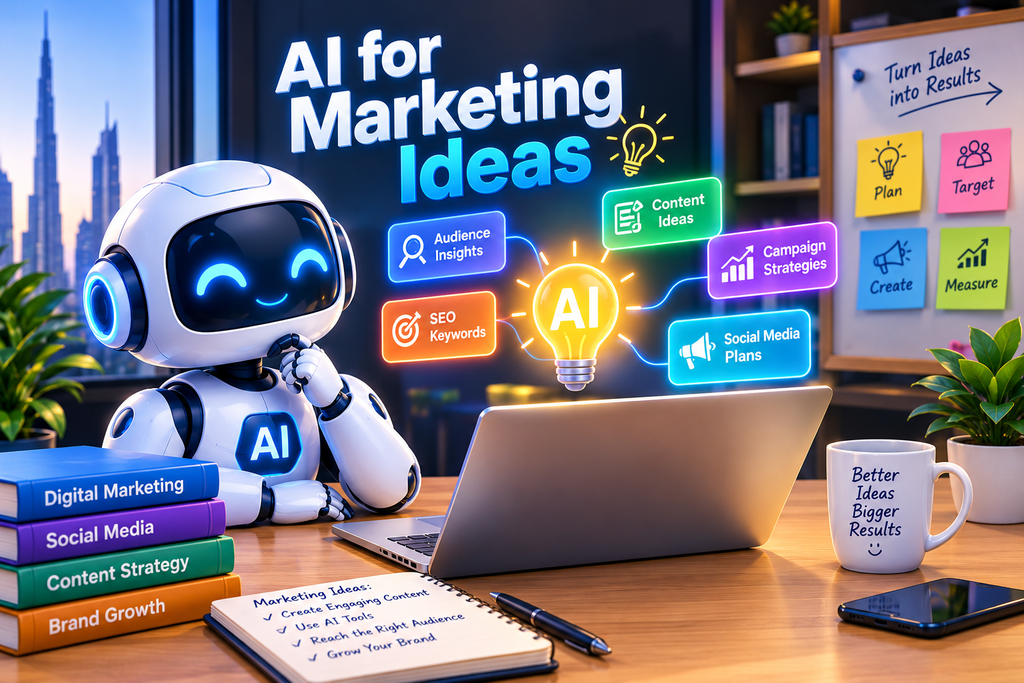
The Five-Step Loop for Applying Applied AI & Marketing
Step One: Start With the Decision, Not the Tool
Before you open any software, write one sentence in this form: “I want to make a better, faster, or cheaper decision about ___.”
Good examples: “I want to decide which products to feature in this month’s newsletter,” or “I want to cut the time we spend answering repetitive shipping questions.” By contrast, “I want to use AI in my marketing” is a vague wish, not a goal.
A specific decision gives you a yardstick for success, and it keeps you from chasing every shiny new tool that appears.
Step Two: Organize Your Data Before You Ask for Intelligence
Think of AI as a fast-learning assistant who knows only what you tell them about your business. The quality of what comes out depends directly on the quality of what goes in.
Start by gathering what you already have: customer lists and purchase histories, past campaign results, frequently asked questions, product reviews, and a clear description of your brand voice. You don’t need massive datasets. Plenty of small businesses get strong results from a single well-organized document that describes the ideal customer, their main objections, and what has worked best so far.
Then build a “context file” that sums up who you are: who you serve, what sets you apart, which words you use and avoid, plus three samples of writing you feel represent you. Reuse it every time. That one habit improves your output more than switching tools ever will.
Step Three: Design the Workflow
The most common mistake is treating AI like a magic button. A better approach is to map the process on paper: What goes in? What does the model do? Who reviews the result? Where does the output get published?
Take an online store that sells skincare products:
- Input: The month’s new customer reviews for a particular product.
- Processing: The model sorts the reviews into themes (scent, absorption, price, packaging) and identifies the dominant sentiment in each.
- Review: A marketing lead reads the summary and checks it against a sample of the original reviews.
- Output: An update to the product page that addresses the most common objection, plus an idea for a short piece of content that answers it.
It’s a small workflow, but it can be repeated every month, and it turns a mess of comments into a decision.

Step Four: Keep a Human in the Loop
No matter how good the models get, they sometimes make mistakes with total confidence. They may invent a fact, overstate a claim, or miss an important cultural nuance. Google itself says as much. Its guidance on generative AI content advises focusing on accuracy, quality, and relevance, and a later update emphasized the importance of human review and fact-checking before publishing.
A practical rule: the more sensitive the content, the stricter the review. An ordinary tweet can be checked in a minute. An ad about a health or financial product, or an email going out to thousands of customers, deserves a careful eye and sometimes a legal check.
And the human’s role goes well beyond proofreading. A person adds the real story from your experience, the personal opinion, the local knowledge of your audience, and the touch that makes a reader feel someone is actually talking to them.
Step Five: Measure, Then Repeat
An implementation you don’t measure isn’t worth much. Before you start, record where things stand today: How many hours does it take to put together the newsletter? What’s your open rate? How long does it take to reply to customers? Then compare after a month or two.
Time saved isn’t the only metric. Also ask: Did the quality of results improve? Did conversion rates go up? Did errors go down? And if nothing improved, there’s no shame in adjusting course or dropping the idea altogether. What matters is that your decision rests on numbers, not on a gut feeling.
Four Areas Where Applied AI & Marketing Makes the Biggest Difference
1. Understanding and Segmenting Customers
Good marketing begins with understanding who you’re talking to. AI can analyze buying and browsing patterns to reveal segments you hadn’t noticed. You might find that one group of customers always buys after a particular email, or that a small segment spends far more than average while you’ve been treating them like everyone else.
Even without complex systems, you can use language models to analyze open-ended survey responses or hundreds of incoming messages and uncover the real reasons people buy, instead of guessing.
2. Creating and Improving Content
This is where most usage happens, and where most mistakes happen too. Smart use doesn’t mean asking the model to write an entire article and publishing it untouched. It means bringing it in at specific stages:
- Brainstorming angles and topics you hadn’t considered.
- Building a first outline, then filling it with your own expertise and examples.
- Turning one piece of content into several formats: an article, then a series of posts, then a short video script.
- Reviewing a draft and suggesting improvements to clarity and structure.
- Generating multiple versions of headlines and ads for A/B testing.
The content that earns the trust of readers and search engines is the content that offers something others can’t: real experience, data from your own work, or a well-considered opinion. In its guide to helpful, people-first content, Google makes clear that it favors content that demonstrates expertise and reliability and truly serves the reader. Generic text that anyone could generate with the same prompt will get lost among millions of similar pages.
3. Personalization and Prediction
Instead of sending the same message to every customer, personalization lets you speak to each segment in the way that suits it best: product recommendations based on past purchases, send times matched to each group’s habits, or an alert when a customer is about to stop buying.
Predictive models, meanwhile, help estimate who is likely to buy, who is likely to leave, and which channels will deliver a better return. They’re not fortune tellers, and every prediction can be wrong. But with enough data, they improve the quality of your decisions compared with plain guesswork.
4. Customer Service and Communication
AI chat assistants can now handle the repetitive questions: shipping times, return policies, product details. Their strength is that they work around the clock and never get tired of repeating themselves.
Success depends on two conditions. First, set clear limits on what the assistant answers and hand everything else to a human. Second, be upfront with customers that they’re talking to an automated system. People forgive a bot that is honest and solves their problem, but they don’t forgive being misled.
How Applied AI & Marketing Is Changing the Job Market
This shift isn’t limited to companies. It reaches marketers themselves. Employers increasingly want people who combine creative instinct with an understanding of data and the ability to manage AI tools wisely. If you’re looking for an opportunity in this field, or building a team, browse the latest jobs in the UAE on JobsDaily to see how the requirements for marketing roles are changing.
The skills in demand today point in a clear direction: data analysis, prompting, workflow design, and output verification. In other words, Applied AI & Marketing has become a learnable career skill, not a distant technical buzzword. And if you want to update your CV to reflect this shift, take a look at the application and CV-writing tips on the site.
Common Mistakes That Cost You the Benefits
Trusting outputs blindly. You publish a claim without checking it, only to find out later that it was wrong. Always verify numbers, claims, and names.
Flooding your channels with mediocre content. Easy production makes quantity tempting, but Google warns against publishing large numbers of pages that add no value for users, which it treats under its spam policy on scaled content abuse. Ten polished pieces beat a hundred forgettable ones.
Neglecting your brand voice. When every company’s copy sounds alike, marketing loses its meaning. Standing out means readers recognize your words before they see your logo.
Ignoring privacy. Feeding sensitive customer data into tools whose policies you haven’t read is a legal and ethical risk. If you operate in the UAE, review the data protection laws on the official UAE Government portal.
Expecting instant results. A good implementation takes weeks of testing and adjustment before it settles down and delivers a clear return.
The Ethics of Applied AI & Marketing: Trust Is Capital You Can’t Rebuy
The more persuasive the technology becomes, the greater the responsibility of those who use it. Some lines shouldn’t be crossed, even when crossing them is profitable in the short term:
- Honesty: Don’t claim your product does something it doesn’t, and never fabricate customer testimonials or reviews.
- Transparency: Tell people when they’re dealing with an automated system, and follow local rules on advertising and disclosure.
- Respect for data: Collect only what you need, protect it, and give customers the right to know how their data is used.
- Avoiding bias: Models learn from human data that can carry stereotypes. Review outputs critically so you don’t exclude or offend a group without meaning to.
For a broader framework on managing risk, the NIST AI Risk Management Framework is an internationally recognized reference whose principles are useful even for small projects. A brand that loses its audience’s trust can’t win it back with any tool.
A Simple 30-Day Plan to Start With Applied AI & Marketing
Week 1: Diagnose. List the repetitive marketing tasks that eat up your time and pick just one or two. Write down your current metrics.
Week 2: Prepare. Build your brand context file, gather examples and data, and sketch the workflow on paper.
Week 3: Test. Apply it on a small scale, with one campaign or one channel, and review carefully by hand. Note what worked and what didn’t.
Week 4: Evaluate. Compare the results against your starting metrics and decide: Do we expand? Do we adjust? Do we stop?
Start small, learn fast, and don’t try to transform your entire organization in a single day.
Conclusion: The Competitive Edge Is in How You Think
Tools will keep changing, improving, and becoming available to everyone at a low cost. What will keep giving you an edge is your way of thinking: starting with the problem, organizing your data, designing a clear workflow, keeping human judgment in the picture, and measuring and learning as you go.
Applied AI & Marketing won’t replace the marketer who understands and respects their audience. But it may well outperform the marketer who refuses to learn how to use it. The opportunity today is open to anyone who treats AI as a working partner rather than a substitute for thinking. Take one step this week, and watch the numbers.

Frequently Asked Questions About Applied AI & Marketing
What is Applied AI & Marketing in simple terms?
It’s the practice of using AI capabilities to solve specific marketing problems, such as analyzing customers, improving content, and serving your audience, within a process you can measure and repeat.
Does a small business need a big budget to benefit from it?
No. Many useful applications, like analyzing reviews, organizing a content plan, and drafting first versions, work with low-cost or free tools. What matters most is being clear about the problem, not the size of your budget.
Will using AI to write content hurt my search rankings?
Google focuses on the quality and usefulness of content for the reader, not only on which tool wrote it. Content that offers real value, clear expertise, and accurate information can perform well. Mass production with no real added value is the most likely to lose ground.
How do I keep my brand voice when using AI?
Create a written guide to your brand’s tone with real examples, give it to the model every time, then review and edit the output yourself.
What’s the best first marketing task to automate?
Start with a repetitive, low-risk task, such as summarizing customer feedback, drafting first versions of social posts, or sorting common inquiries.
Will AI replace marketers?
More likely, it will reshape the tasks within the job. Routine work will shrink, while strategic thinking, customer understanding, creativity, and ethical judgment will become more valuable.
How do I know if it’s working?
Set your metrics before you begin, such as time spent, conversion rate, and response time, and compare them after a trial period.
Is it safe to enter my customers’ data into AI tools?
It depends on the tool’s policy and the nature of the data. Avoid entering sensitive personal data without checking the privacy policy, anonymize where possible, and comply with local regulations.
Table of Contents

“The Jobs Daily editorial team is dedicated to tracking and publishing the latest verified job opportunities across the United Arab Emirates. We assist job seekers by providing career guides and resume optimization strategies designed to pass Applicant Tracking Systems (ATS).”