


A practical guide to what the job involves, the skills and tools it demands, the challenges that come with it, and why it has become one of the most closely watched careers in tech.
Introduction: When Software Stops Waiting for Commands
For decades, our relationship with software has been simple: we click a button, and the program does what it was told. Even the automation tools of the last ten years stuck to that deal. They follow a script written in advance, and when something happens that the script’s author didn’t anticipate, they stall or get it wrong.
Something different is happening now. A new class of systems can take a broad goal, such as “analyze this week’s customer complaints and send me a report on the three biggest problems,” and work out how to get there on their own. They search a database, read the messages, sort them, check their own results, and try again if something looks off. These systems are known as agentic AI, and the person who designs them, builds them, and makes sure they behave safely in a real business environment is the focus of this guide: The Agentic AI & Automation Engineer.
This guide to The Agentic AI & Automation Engineer looks at the role honestly: what it is, how it differs from nearby jobs, which skills matter most, what makes the work harder than product demos suggest, and how someone can realistically get started.
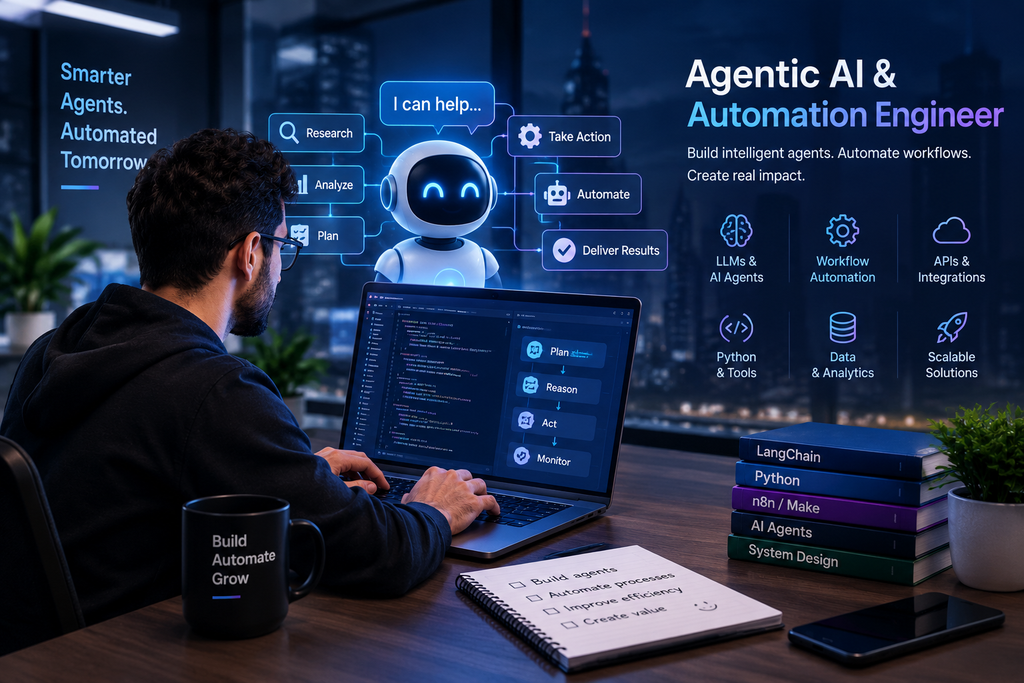
What Does “Agentic AI” Actually Mean?
An agent, in this context, is a system built around a large language model that acts as its decision-making core. But it does more than generate text. It can plan, breaking a goal into steps. It can use tools, such as search engines, databases, APIs, email, and spreadsheets. It can observe the results of its actions and adjust course. And in some designs it can remember what happened in earlier sessions.
Think of the difference between an employee who follows a detailed checklist line by line and one you can simply hand a task to, expecting a finished result. The first is easy to control but limited. The second is far more useful but needs clear boundaries, sensible permissions, and some oversight. That is exactly where the engineer comes in. The goal isn’t just to make an agent clever. It’s to make it dependable.
Traditional Automation vs. Agentic Automation
Traditional automation, whether it’s a Python script, an integration between two apps, or robotic process automation (RPA), works well when steps are fixed and inputs are predictable. An invoice in a known format gets read and entered into the accounting system. Done.
But real work is messy. A customer writes an angry email in their own words. A PDF arrives in a layout nobody has seen before. A request needs a judgment call that depends on context. This is where traditional automation breaks down and where agentic systems earn their keep, because they can handle natural language, ambiguity, and exceptions.
That said, it would be a mistake to think agents replace traditional automation. Good engineers use both. Anything predictable goes to a plain script, because it’s faster, cheaper, and more consistent. The agent is reserved for the parts that genuinely require understanding and judgment. That one principle alone saves companies a lot of wasted effort and money.
Who Is The Agentic AI & Automation Engineer, Exactly?
At its core, The Agentic AI & Automation Engineer is a software engineering role. It combines solid systems-engineering skills with a deep, practical understanding of how language models behave. This person isn’t a researcher training models from scratch, nor an analyst who lives in dashboards. They sit in the middle: they take existing models and turn them into systems that do real work inside a company’s processes.
How It Differs from Neighboring Roles
A machine learning engineer typically focuses on training, tuning, and statistically evaluating models. The agentic engineer treats the model as one component in a larger system, and much of the job is conventional engineering: APIs, queues, permissions, error handling.
A traditional automation engineer connects systems using fixed rules. The agentic engineer does that too, but adds a flexible decision layer and takes responsibility for keeping its behavior in check.
A prompt engineer, a title that became popular in the early days of language models, focuses on crafting instructions. That is only a small part of what an agentic engineer does. Good prompts matter, but they’re not enough to build something a business can rely on.
What a Typical Workday Looks Like
It looks nothing like the flashy demo videos. The day often starts by reviewing last night’s logs. Which agent got stuck in a loop? Which tool call failed? Why did the agent email the wrong person? From there, the engineer might fix a specific problem, perhaps rewriting a tool’s description because the model kept misunderstanding it, or adding a human approval step before any financial action.
A great deal of time goes into building test suites that mimic real-world cases, because a small tweak to one instruction can improve one behavior and quietly break another. On other days, the engineer sits down with the sales, support, or finance team to understand how the work really gets done. Automation built on a wrong picture of the process fails no matter how elegant the code is.
Core Technical Skills
Programming and Systems Engineering
Python is the most widely used language in the field, followed by JavaScript and TypeScript, especially for web-facing services. But the language itself isn’t the point. Engineers need to understand asynchronous programming, design clean APIs, work with queues and background jobs, handle errors gracefully, and write code that can be tested and maintained. People who skip these fundamentals tend to build impressive prototypes that fall apart within a week in production.
Understanding Language Models in Practice
You don’t need to derive the math behind attention mechanisms, but you do need to know the models’ limits: how they’re affected by context length, why they sometimes make things up, how they differ in following instructions and calling tools, and when a smaller, cheaper model is good enough. This practical intuition drives most of the important architectural decisions.
Designing Tools
An agent without tools is just a chatbot. And the quality of the tools you give it largely determines the quality of what it produces. A tool with a vague description, or one that takes too many similar-looking parameters, will confuse the model. Experienced engineers design each tool the way they’d design an interface for a new colleague: a clear name, a precise description, few inputs, and useful error messages that help the agent correct itself.
Retrieval and Memory
Most business systems need an agent to draw on information specific to the company: policies, contracts, product documentation, past tickets. That’s why retrieval-augmented generation (RAG), vector databases, and document-chunking strategies are core skills. Just as important is knowing when you don’t need them. Sometimes a direct SQL query beats any elaborate retrieval setup.
Coordinating Multiple Agents
Many projects start with a single agent and later split into several specialists: one gathers information, another drafts, a third reviews. This can make the system clearer and easier to inspect, but it also adds failure points, cost, and complexity. A rule that seasoned engineers follow: start with the simplest design that works, and add another agent only when testing shows a single one can’t cope.
Evaluation and Monitoring
This is the skill that separates a prototype from a product. A system that worked five times in a manual test says little about the next thousand cases. Engineers need clear metrics, such as task completion rate, steps taken, cost per run, and how often a human has to step in, along with detailed logs that let them replay any failed run and see exactly where things went wrong.

The Non-Technical Skills That Matter Just as Much
Newcomers often assume this field is purely technical. Experience says otherwise.
The first is process analysis: sitting with someone who handles a hundred requests a day and understanding why they do what they do, including the small decisions nobody ever wrote down. The second is communication. You’ll need to explain to a non-technical manager why a certain step requires human approval, and to tell them plainly what the agent cannot do today. The third is judging feasibility: knowing when automation is a smart investment and when it’s just an interesting project that saves nothing.
There’s a fourth skill that rarely gets mentioned: humility in the face of failure. Agentic systems fail in surprising ways. Engineers who treat each failure as useful information rather than an embarrassment are the ones who improve their systems fastest.
Common Tools and Frameworks
The tooling in this field changes quickly, so it’s wiser to understand the principles than to memorize library names. Still, most engineers work across a few broad categories:
- Language models from different providers, accessed through APIs, with attention to cost, latency, and rate limits.
- Agent frameworks that manage state, tools, and workflows, such as LangGraph, though plenty of strong agents are built with plain code and no framework at all.
- Tool-connection protocols like the Model Context Protocol (MCP), which standardizes how models connect to external systems.
- Low-code automation platforms such as n8n, Zapier, and Make, which are great for prototypes and for workflows that don’t need complex logic.
- Vector and traditional databases for storing knowledge and state.
- Tracing and evaluation tools that record every step an agent takes and let you compare versions.
- Cloud platforms and containers for running services securely and at scale.
One honest piece of advice: don’t start with the biggest framework. Many successful production agents are little more than a simple loop of a hundred lines or so that calls a model and runs tools. Any framework you add later should earn its place.

Real-World Use Cases
Customer support. An agent reads a request, checks the customer’s history, and either suggests a reply or takes a simple action, like issuing a refund below a set limit. Sensitive cases go to a human with a ready-made summary. The benefit isn’t replacing the support rep; it’s cutting the time they waste searching and retyping.
Finance operations. Matching invoices to purchase orders, flagging mismatches, and drafting recurring reports. This is where limited permissions and audit trails matter most. The agent should never be able to release a payment without human sign-off.
Software engineering. Agents that review code, write tests, and propose fixes for recurring bugs. This is one of the most mature applications today because results can be verified automatically: either the tests pass or they don’t.
Research and analysis. Gathering information from multiple sources, summarizing it, and organizing it, with citations so a person can check the work.
Marketing and content operations. Preparing drafts, scheduling posts, and analyzing campaign performance, while final review and strategic decisions stay with the team.
The Challenges Demos Don’t Show
Reliability. A model might succeed nine times and fail unpredictably on the tenth. In multi-step processes, small errors compound: a system that does well at each step can still have a noticeably lower overall success rate once a task stretches past ten steps. That’s why good engineers keep workflows short and add checkpoints.
Security. The moment you let a system take actions, you have to ask what happens if it’s tricked. In a prompt injection attack, a document or email contains hidden text that redirects the agent to do something the user never asked for. Defenses include granting the minimum permissions necessary, isolating sensitive tools, treating any text from outside sources as untrusted, and requiring human approval for actions that can’t be undone.
Cost and latency. An agent that loops without limits can burn through a month’s budget in a night. Engineers set caps on steps and spending and monitor usage constantly.
Privacy and compliance. Any system that touches customer or employee data falls under data protection rules. You have to know where data is sent, how long it’s stored, and who can see it.
Team adoption. The best system will fail if people don’t trust it or feel threatened by it. Bringing the people who do the work into the design from the start makes an enormous difference.
Governance and Responsibility: What Should Stay in Human Hands?
Not everything that can be automated should be. Decisions that affect people’s rights, such as hiring, denying credit, or assessing health, need genuine human oversight, not a rubber-stamp button that gets clicked without thought. Good practice includes documenting what the agent can and can’t do, logging every decision along with its reasoning, assigning a named owner to each system, and building a clear way to shut an agent down immediately if something goes wrong.
How to Become The Agentic AI & Automation Engineer
There’s no single path, but this sequence has worked for many people:
- Get comfortable with programming fundamentals in Python, including APIs, databases, and error handling.
- Work directly with language model APIs and try tool calling yourself before reaching for any framework.
- Build a small agent for a real problem of your own, such as sorting your inbox, summarizing your work sources, or organizing files. A real project teaches more than ten tutorials.
- Learn evaluation early. Write a set of test cases and measure every change against it.
- Study security. Try tricking an unprotected agent yourself to see how it happens.
- Document your projects publicly, for example on GitHub, explaining the problem and the decisions you made. Employers pay more attention to this than to certificates alone. Once your portfolio is ready, browse the latest tech and AI jobs in the UAE to see what employers are asking for.
- Follow the field regularly but selectively. The news is endless, while the fundamentals change far more slowly than headlines suggest.

Where the Profession Is Heading
Demand for these skills is growing as companies experiment with intelligent automation, and the Arab world is no exception: several countries have launched national AI programs, and businesses are investing in digital transformation. Engineers who understand local contexts and can work well in Arabic have a particular edge, since many imported solutions struggle with dialects, formal registers, and local compliance requirements. You can follow how demand is evolving through the latest UAE job listings on JobsDaily.ae.
Still, it pays to look past the hype. Job titles come and go, and what’s in demand today may be folded into broader engineering roles tomorrow. The lasting skills are understanding how work really gets done, building reliable systems, and thinking critically about what the technology can and can’t do. Whoever has those will find a place whatever the job title says.

Frequently Asked Questions
Do I need a computer science degree? Not strictly, but software engineering fundamentals are essential. Plenty of people have entered the field from other backgrounds and built their expertise through projects.
Will AI agents replace programmers? It’s more likely they’ll change the nature of the work than eliminate it. Routine tasks will shrink, while demand grows for people who design systems, review them, and take responsibility for their outcomes.
What’s the difference between an agent and a chatbot? A chatbot mostly answers questions. An agent plans, takes actions through tools, and checks the results.
How long does it take to learn? Someone with a programming background can build a first working agent within weeks. Reaching the level of building dependable production systems takes months of practice on real cases.
The Agentic AI & Automation Engineer isn’t a magician, and this isn’t a passing fad. It’s a natural extension of software engineering into an era when software can reason a little and act on its own. The value of this engineer lies not in knowing the newest framework but in combining a deep understanding of the work, calm and careful system design, and a firm commitment to safety and accountability. Anyone who starts today with a small, real project, learns from their mistakes, and measures results honestly is setting out on a path that will stay open for many years to come. Ready for the first step? Explore current openings on JobsDaily.ae and start building toward your next role.
Table of Contents

“The Jobs Daily editorial team is dedicated to tracking and publishing the latest verified job opportunities across the United Arab Emirates. We assist job seekers by providing career guides and resume optimization strategies designed to pass Applicant Tracking Systems (ATS).”


