Landing an ADNOC job doesn’t start when you click “Apply Now”. It starts with understanding the system you’re trying to enter. Every year, thousands of applicants submit their CVs and then wait. A week passes, then a month, and nothing comes back. Many conclude that connections decide everything, which is a comforting theory but usually not an accurate one. More often, the application went to the wrong place, in the wrong form, or through a pathway that was never meant for that applicant.
Every year, thousands of people click “Apply Now” on a job portal and then wait. A week passes, then a month, and nothing comes back. Many conclude that connections decide everything. It’s a comforting theory, but usually not an accurate one. More often the application went to the wrong place, in the wrong form, or through a route that was never meant for that applicant.
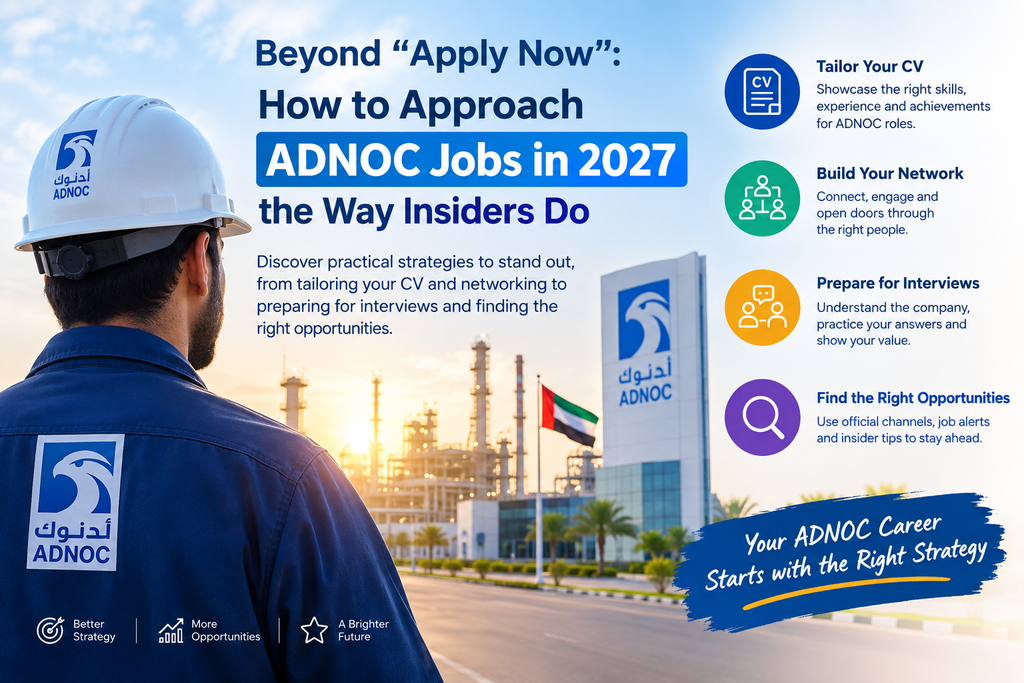
This article won’t repeat the usual “register, upload your CV, and wait.” Instead, I want to show you how to think about ADNOC as a system before you think of it as an employer. The practical steps come after.
1. ADNOC Isn’t One Door
ADNOC is a group of companies and specialized units covering production, refining, distribution, logistics, petrochemicals, and more. Each has its own needs, culture, and hiring rhythm. The official careers portal jobs.adnoc.ae lets you filter by job category, country, hiring type, company, and location. Those filters exist for a reason, so use them.
Picture a hypothetical engineer, Maryam. She applied three times for “any engineering role” and heard nothing. On her fourth attempt, she read up on what each company in the group actually does and realized her interest in continuous industrial operations fit one company in particular. She rewrote her CV for a specific role with a clear title, and the outcome changed. Her qualifications stayed the same. What improved was the fit.
2. Know Which Pathway Is Yours
This is where many applicants lose time.
UAE Nationals who have just graduated: There is a two-year training and development program designed to prepare high-calibre graduates for permanent employment. Its stages include an online application, ability and personality assessments, a technical interview with subject-matter experts, then medical checks and government clearances. The job postings also make clear that finishing the program doesn’t guarantee a permanent contract. Treat it as a chance to prove yourself, not a guaranteed job.
Students and high-school pupils: There’s a summer internship for university students and the RO’YA program for Emirati students who have completed Grade 10, along with scholarship opportunities. adnoc
Experienced professionals (nationals and expatriates): You apply to specific roles posted on the portal, and the decision comes down to how closely your experience matches the position. The graduate program above is reserved for UAE Nationals, so don’t build your plan around it if you’re a resident expatriate.
Current ADNOC employees: Internal moves go through a separate internal portal, and employees are encouraged to discuss their aspirations with their line managers first.
Requirements and dates change, so check the official page early in 2027.
3. Read a Job Posting Like a Contract
A job ad is a document written to filter applicants. The recruitment team reviews applications against the role’s requirements, so:
- Separate must-haves from nice-to-haves. A stated requirement is rarely waived, while a “preferred” item can be offset by other experience.
- Notice the language. If “safety,” “reliability,” or “continuous improvement” keeps coming up, those are real priorities. Show them in your CV through honest examples rather than copied phrases.
- Mind the exact title. An operations engineer and a reliability engineer do very different work.
4. Your CV Is an Argument, Not a Record
A recruiter isn’t asking “What did you do?” but “What will change if I hire you?” Turn duties into impact.
Instead of: “Responsible for following up on routine equipment maintenance.”
Write: “Reduced unplanned equipment downtime by scheduling preventive maintenance and documenting results weekly.”
If you don’t have precise figures, don’t invent them. A small, honest result beats a big number you can’t defend in an interview. Keep your CV to about two pages, use simple formatting without complex tables, and proofread carefully, especially company names and job titles.
5. Scams Use ADNOC’s Name
A name like ADNOC attracts fraudsters. The rule is simple: never pay money for a job, an interview, or a “fast-tracked” application. Always confirm that the role is listed on the official portal, and check the sender’s email domain before replying or sharing personal details.
6. Preparing for Assessments and Interviews
Ability and personality assessments are taken online, so practice numerical and verbal reasoning under a timer. The goal is to get used to time pressure, not to memorize answers.
In a technical interview, start with the principle, then move into detail. Don’t be afraid to say, “I don’t know, but here’s how I’d find out.” In an industry where mistakes are measured in safety terms, professional humility counts in your favor.
For behavioral questions, prepare real stories: a time you spotted a hazard, caught an error, or objected to an unsafe procedure. An honest story convinces far more than calling yourself “committed to safety.”
7. A Story from the Field
[Insert your own real experience here. This is the most valuable part of the article, because nobody can copy it.] In a paragraph or two: When did you, or someone you know, apply for a job in the energy sector? What mistake taught you the most? Which interview question caught you off guard? How long was the wait? What would you do differently?
8. Patience, and What to Do While You Wait
There is no magic timing. Check the portal regularly, keep your profile updated, and sign up for job alerts. While you wait, invest in a professional certification, a safety course, or your English, which is the day-to-day working language in an international environment.
9. On Rejection
Rejection happens even to strong candidates because competition is fierce. It isn’t a verdict on your worth. After each attempt, ask yourself: was it the role I chose, my CV, or my preparation? Then adjust and try again.
The Bottom Line
Applying to ADNOC job in 2027 doesn’t start when you open the portal. It starts when you work out which pathway is truly yours. Choose the company and role deliberately, write your CV as an argument, stick to official channels, and put honesty and safety-mindedness ahead of polish. No article can guarantee you a job, but this approach genuinely improves your odds. Before you decide anything, check jobs.adnoc.ae, because the details change.
“If you’re a recent graduate, see our guide to fresh graduate jobs in the UAE.”
Table of Contents

“The Jobs Daily editorial team is dedicated to tracking and publishing the latest verified job opportunities across the United Arab Emirates. We assist job seekers by providing career guides and resume optimization strategies designed to pass Applicant Tracking Systems (ATS).”