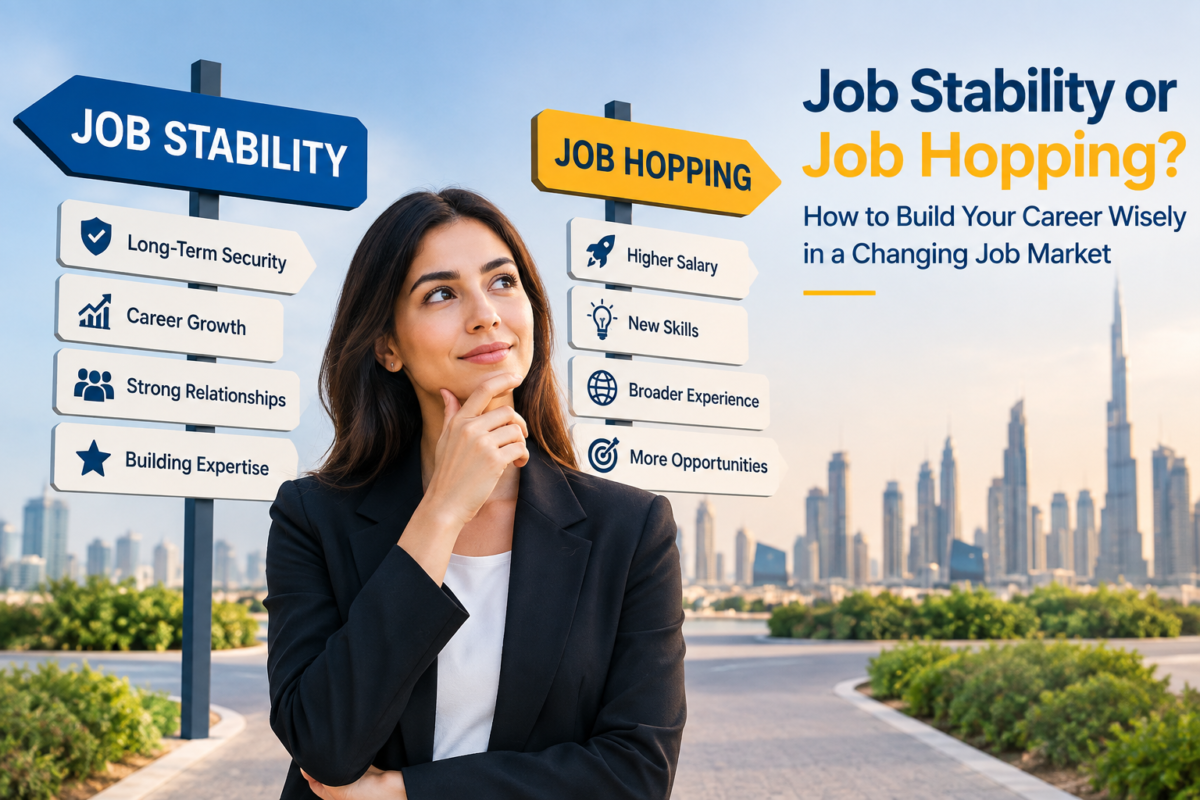
“How long have you been in your job?” used to be a question people answered with pride. For generations, the ideal career was a single job that lasted thirty years and ended with a retirement party and a commemorative watch. Today the picture looks very different. Many young professionals list four or five employers on their résumés within ten years, and that is often read as ambition rather than restlessness.
Caught between these two cultures, job seekers are left wondering: should I hold on to my current job for the sake of security, or move on in search of better pay and better opportunities? The truth is that the question itself can be misleading. This isn’t a battle between two camps. It’s a decision that depends on your circumstances, your career stage, and your personal goals. In this article, we’ll look at where each culture comes from, what each offers and what each risks, and then lay out a practical framework for How to Build Your Career with confidence. Learning How to Build Your Career begins with understanding both sides.
The Culture of Job Stability: Where It Comes From
Job stability has traditionally rested on an unwritten “psychological contract” between employee and employer: the employee offers loyalty and years of service, and the organization offers job security, steady promotions, and a guaranteed retirement. In the Arab world, this model was reinforced by the prominence of government jobs and large institutions that offered attractive social benefits. A “stable job” became almost a social prerequisite for marriage, family life, and a good reputation.
But the culture of stability isn’t only about financial security. It carries other values too: loyalty to the organization, long-term relationships, a logical climb up the career ladder, and the belief that frequent job changes signal immaturity or an inability to adapt.
The Advantages of Job Stability
When thinking about How to Build Your Career, it helps to weigh what stability actually offers.
1. Financial and emotional security. A steady income eases anxiety and makes long-term planning possible: investing, buying a home, raising children, and building an emergency fund. Research in occupational psychology consistently links a sense of job security to lower stress levels.
2. Depth of expertise and institutional knowledge. People who stay with one organization for years understand its culture, processes, and clients in a way newcomers simply can’t. This kind of tacit knowledge is rare, hard to transfer, and hard to replace quickly.
3. Strong professional relationships. Trust takes time. An employee whom managers and colleagues have known for years carries a credibility that opens the door to sensitive projects and leadership roles.
4. Internal growth opportunities. Organizations often prefer to promote people whose abilities and loyalty they already know rather than gamble on an outside hire, and they may invest in training and developing those employees in the hope of keeping them long-term.
5. Benefits that build over time. Many perks are tied to length of service: end-of-service bonuses, growing leave entitlements, better health coverage, stock plans, and long-term incentives.
The Downsides of Too Much Stability
Stability has another side that many people overlook. How to Build Your Career is never about simply staying comfortable, and the biggest danger of stability is the comfort zone. Once tasks become routine and the challenge disappears, an employee may believe they’re advancing when they’re really repeating one year of experience ten times over.
Other risks include:
- Stagnant pay: Annual internal raises are often smaller than the jump you could get by moving to a new employer.
- Skills erosion: Tools and technologies change fast, and staying in an environment that doesn’t keep up can leave your skills behind the market.
- The illusion of safety: No job is completely guaranteed. Mergers, restructuring, and automation can eliminate even long-standing positions, and someone who spent two decades at one company may suddenly find themselves in a market they haven’t navigated in years.
- A narrow professional network: Your relationships are concentrated inside one organization, which limits outside opportunities and your awareness of what’s happening in your industry.
The Rise of Job-Hopping Culture
Several factors have chipped away at the idea of one job for life, and together they have changed How to Build Your Career for an entire generation:
- Rapid technological change: Roles that didn’t exist a few years ago are now in demand, while whole categories of jobs have disappeared. Moving between employers has become a way to keep pace.
- Remote work and digital platforms: Many people can now apply for jobs outside their geographic area without relocating.
- Shifting generational values: Millennials and Gen Z tend to look for meaning, flexibility, and continuous learning, not just security.
- Greater transparency in the job market: Job boards, recruitment sites, and professional networks have made it easier than ever to compare salaries and opportunities.
- Fading mutual loyalty: When younger generations see companies cut jobs at the first sign of crisis, they conclude that unconditional loyalty isn’t being returned in kind.
The Risks of Frequent Job Changes
In the same breath, older research on executive careers pushes back on the idea that hopping is always the fastest route up. One widely cited study of thousands of financial-industry executives and CEOs found that people who stayed put often advanced further than serial job-changers, and that switching employers doesn’t automatically mean a step up a meaningful share of moves turn out to be lateral or even a demotion (Harvard Business Review research, summarized by Management Issues).
The Advantages of Changing Jobs
Many professionals now treat a well-timed move as a tool for learning How to Build Your Career faster.
1. Faster income growth. Moving to a new employer often lets you negotiate a salary that reflects your current market value, rather than settling for a modest annual raise.
2. A broader range of skills. Every workplace teaches you different tools, methods, and cultures. Someone who has worked at a startup, then a large corporation, then a consultancy has a wider perspective than someone who has followed a single path.
3. A bigger professional network. Each new employer adds colleagues, managers, and clients who may open doors for you down the road.
4. A way out of toxic environments. Staying in an unhealthy workplace just for the sake of “stability” costs you in mental health, productivity, and ambition. Sometimes leaving is a healthy decision, not a reckless one.
5. Greater adaptability. If you’re used to adjusting quickly to new teams and systems, you’re better prepared for major shifts in the market.
The Risks of Frequent Job Changes
Anyone serious about How to Build Your Career should also weigh a cost that isn’t always visible right away:
- A reputation for lacking commitment: Employers may hesitate to invest in someone they suspect will leave in a few months, especially for roles that require costly training.
- Shallow experience: Leaving before you’ve seen a full cycle of projects means you never see the results of your decisions or learn the deeper lessons. You collect job titles without meaningful accomplishments.
- Lost cumulative benefits: Loyalty bonuses, deferred stock, and promotion priority all go out the window.
- Rebuilding trust from scratch: At every new company, you start almost from zero in reputation and relationships.
- Carrying the same problem with you: If you keep leaving because of recurring conflicts or difficulty working with managers, changing employers won’t fix it.

How Do Employers See It Today?
Hiring managers’ attitudes have shifted in recent years. Changing jobs is no longer automatically a red flag. It has become common in many sectors, especially tech, marketing, and sales. Recruiters now look at how candidates approach How to Build Your Career, and what matters most is the story your résumé tells.
A résumé showing a move after two or three years, accompanied by a promotion, broader responsibilities, and completed projects, tells a convincing story of growth. A résumé with several jobs of only a few months each and no clear explanation raises fair questions about discipline and commitment.
Expectations also vary by industry. What’s perfectly normal at a startup may stand out in more traditional sectors like banking or government. And stability remains a strength when paired with growth: five years in one role with a clear expansion of responsibilities shows competence, while five years with no development adds nothing.
How to Build Your Career: When Should You Stay, and When Should You Go?
There’s no rigid numerical rule, but a few questions can help you assess your situation.
Good reasons to stay:
- You’re still learning new skills and facing real challenges.
- There’s a clear, realistic path to promotion within a reasonable time.
- The work environment is healthy and supports both your growth and your work-life balance.
- Your pay is fair relative to the market, or there are credible, verifiable promises to improve it.
- You’re close to a milestone that will strengthen your résumé, or to benefits tied to length of service.
Signs it may be time to move on:
- You stopped learning a long time ago and your tasks have become repetitive.
- The company is declining, struggling financially, or has no clear vision for its future.
- There’s a large gap between your salary and what the market offers people with your experience.
- The work environment is hurting your mental or physical health.
- Your efforts are repeatedly overlooked and there’s no prospect of advancement despite strong performance.
Before you decide, ask yourself honestly: am I running away from a problem I could solve by talking to my manager? Or is the problem structural, something no negotiation will fix? Asking these questions candidly is a core part of How to Build Your Career.
Practical Tips on How to Build Your Career
1. Think in “seasons,” not a single model. Early in your career, moving around can help you explore your interests and broaden your experience. Later, staying put may help you build depth and lead a team. How to Build Your Career looks different at 25 than it does at 45.
2. Make every move a step forward. Each change should bring something clear: greater responsibility, a new skill, better pay, or a healthier environment. A move without a convincing reason is hard to defend in an interview.
3. Deliver before you leave. Try to finish a project or achieve a measurable result before you go, so you leave with an accomplishment for your résumé and good relationships behind you.
4. Keep developing your skills wherever you are. A stable employee who keeps learning is more competitive than a job hopper who never masters anything in depth. Your ability to learn is your real safety net, not the name of your employer. Knowing How to Build Your Career around skills rather than job titles is the smartest long-term strategy.
5. Keep your professional network active. Even if you’re happy in your job, stay in touch with peers and follow developments in your field. It reduces the risk of nasty surprises.
6. Master the story of your career. If you’ve changed jobs often, give those moves a logical frame in your résumé and interviews, explaining what you learned and achieved at each stop, rather than leaving the reader to draw their own conclusions.
7. Look at the whole offer, not just the salary. Weigh the work environment, management culture, growth prospects, end-of-service benefits, and work-life balance alongside the pay.
How to Build Your Career on Insight, Not Impulse
Job stability isn’t an absolute virtue, and changing jobs isn’t necessarily a flaw. The former offers depth, security, and lasting relationships, but it can lull you into complacency if it isn’t paired with learning and growth. The latter offers speed, flexibility, and variety, but it can leave you shallow and rootless if it becomes a habit with no purpose behind it.
The smart professional doesn’t ask, “Which is better?” but rather, “What do I need right now in my career?” Sometimes the answer is “stay and go deeper.” Other times it’s “move on and broaden my horizons.” In either case, the real measure of success is growth: finishing each year of work more experienced, more valuable, and more capable than when you started it.
And remember, your job is more than a source of income. It’s a journey through which you build your market value and your professional story. So make your decisions deliberately, and build your career on insight, not on fear or impulse.
Table of Contents
“To keep pace with rapid changes in the labor market and identify the skills required for the future, you can leverage national programs such as the Emirates Skills Platform by the Ministry of Human Resources and Emiratisation (MOHRE) to accurately plan your career path.”
Read more about career advice
find more jobs here

“The Jobs Daily editorial team is dedicated to tracking and publishing the latest verified job opportunities across the United Arab Emirates. We assist job seekers by providing career guides and resume optimization strategies designed to pass Applicant Tracking Systems (ATS).”