

Special Education Services: Your Proven Path to the Right Support
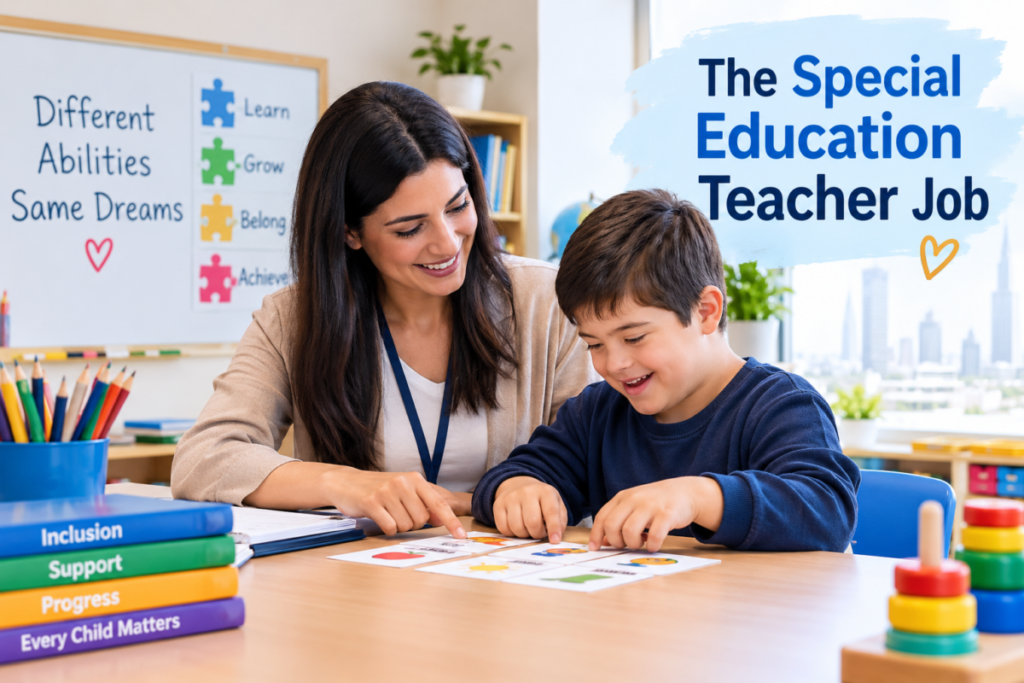
Special Education in the UAE has expanded significantly over the past decade, with new inclusion policies reshaping how schools serve students with learning differences.
Special Education gives students with disabilities the individualized instruction and support they need to succeed in school.
Choosing the right Special Education program can feel overwhelming for parents who are just starting the process.
A special education teacher is one of the most important and sought-after roles in the UAE today. It’s a career that blends compassion with pedagogy the teacher’s job is to support children and students with special needs, and often to help shape their behavior, since many of these children need extra guidance to develop their social, academic, and behavioral skills.
With inclusive education programs spreading rapidly across schools, and growing investment in creating learning environments that work for every student, special education has become one of the most valued fields in the education sector. It’s proven its impact time and again, and special education teaching jobs in the UAE now attract highly qualified, experienced professionals.
In this article, we’ll walk through what the job actually involves, the qualifications you’ll need, the core responsibilities, how to handle tricky situations, the skills worth building, and how to boost your chances of landing a role in this field.
What Does a Special Education Teacher Do?
A special education teacher specializes in supporting students with special needs through creative, tailored teaching methods. The role calls for a particular set of skills suited to working with these students. It’s not just about teaching it’s about setting learning goals, understanding each student’s individual needs, and building a personalized plan that fits their abilities and leads to real progress over time. The teacher also tracks that progress alongside the family, the school, and if the student attends a center a special education specialist.
Special education teachers often work with a wide range of cases, including students with:
- Learning difficulties
- Attention and focus disorders
- Communication disorders
- Physical disabilities
- Behavioral challenges
- Higher-than-average learning support needs
- Autism or autism spectrum disorder
- Developmental delays
How to Land a Job as a Special Education Teacher
Build a strong resume. Highlight the skills relevant to the field and include your qualifications in special education.
Showcase your experience. If you’ve worked with children or students with special needs before, briefly describe your achievements, the tasks you handled, and the skills you picked up along the way.
Keep developing your skills. Pursue certifications and courses in related areas behavior modification, learning difficulties, communication disorders since this significantly boosts your chances of getting hired.
Search actively on trusted job platforms. Try different search terms like “Special Education Teacher” or “SEN Teacher” across various cities. You can also search directly on Google Maps for schools near you you’ll likely find several nearby schools and centers you can reach out to directly.
Prepare thoroughly for the interview. Expect questions testing your practical skills, like: “How would you handle a child who hit you or tried to?” or “How do you deal with a student who throws materials or refuses to participate?” Your answers need to be professional and demonstrate that you can handle difficult situations calmly and effectively. A strong, thoughtful answer shows your competence and it’s often what gets you the job.
The Perks of This Career
- Room to grow. A teaching assistant, for example, can work toward becoming a certified special education teacher.
- Skill-building. You’ll sharpen your communication, behavior management, and individualized instruction skills.
- Specialization options. You can focus on a particular area autism, learning difficulties, early intervention, and more.
- Broad, hands-on experience working with a wide variety of cases and behaviors.
Useful Certifications
Some of the most valuable certifications for this career path include:
- Applied Behavior Analysis (ABA)
- Inclusive Education
- Augmentative and Alternative Communication (AAC)
- Learning Difficulties Certification
- Early Intervention Certification
- Classroom Management Certification
- Behavior Modification Certification
- Certification in Autism Spectrum Disorder (CAS)
Key Challenges of the Job
- Difficult cases require patience. Some situations are genuinely tough, and it takes real persistence not to lose hope in these students.
- Repetition and adaptation. Every student’s individual plan requires different methods depending on their specific challenges.
- Managing difficult or aggressive behavior. Some students may act out physically. Staying calm and professional and having a plan to understand and address the root cause is essential.
- Ongoing communication with families. Many parents are cooperative and understanding, working hand-in-hand with teachers and specialists, and the results show in the student’s academic and behavioral progress. Unfortunately, some parents struggle to accept their child’s diagnosis, which can create friction with the school and, in the worst cases, a total lack of communication ultimately hurting the student.
- Working within a multidisciplinary team. Staying open and collaborative with other specialists, and learning from more experienced colleagues, is part of growing in this field.
Tips for Success in Special Education
- Use varied, engaging teaching methods incorporating characters or games the child loves can make learning fun and hold their attention.
- Regularly track student progress with the family and other teachers, and keep everyone informed about the individual plan and how best to work with the student.
- Support fellow teachers by sharing tips on handling students with special needs, since special education teachers often have more relevant experience than general classroom teachers.
- Reinforce positive behavior rewards can help, but shouldn’t become the only reason a student behaves well; avoid making every good action contingent on a prize.
- Keep learning take additional courses to sharpen your skills.
- Document progress against the individual plan regularly, and keep parents updated on both gains and setbacks, whether academic or behavioral.
- Stay curious about new strategies in inclusive education.
- Set clear, achievable goals within the individual plan, and raise the bar gradually as the student shows progress.
- Encourage classmates to include and support the student giving them tasks suited to their abilities and meaningful roles in the classroom.
- Above all, this job takes a great deal of patience and skill.
In Closing
A career as a special education teacher in the UAE is a rewarding path for anyone with the skills and drive to help students improve academically and personally, reach their goals, and thrive within inclusive education. It’s about supporting students socially and empowering them to make the best behavioral and educational choices they can.
Never give up on special education students, no matter their behavior or abilities they simply need the right support to grow and thrive, and to build strong, positive connections with the people around them.
When “Success” Gets Redefined: The Side of Special Education Teaching No
Certificate Prepares You For
There’s a simple question that reveals a lot. Ask any special education teacher, a few years into the job: “How do you know when your day went well?”
The answer will probably surprise you. You won’t hear about a test score, a fully completed plan, or a goal ticked off exactly as written. You’ll hear something closer to: “Today he held eye contact with me for a few seconds straight.” Or, “Today she didn’t throw the pencil when I asked her to write.” Or simply, “Today was calmer than yesterday.”
These aren’t modest answers meant to downplay the job. They point to something deeper a shift that happens to anyone who takes this work seriously, and one that rarely comes up when people write about the profession: a special education teacher doesn’t just learn how to teach. She learns how to redefine what time, and what success, even mean.
A Job That Trains You to Stop Comparing
In almost every other teaching role, there’s some invisible yardstick behind the scenes: the curriculum, the child’s age, the rest of the class, “where they should be by now.” In special education, that yardstick falls apart within the first few weeks on the job.
What a new teacher discovers often the hard way is that comparison simply doesn’t work here, and can actually do harm. The child in front of her isn’t measured against the kid next to them, or against some expected benchmark from a developmental textbook. Progress gets measured against one thing only: that same child, yesterday, last week, last month.
It sounds like a minor mindset shift on paper. In practice, it’s a complete rewiring of how you think. A teacher who spent her whole academic and professional life around clear benchmarks and direct comparisons suddenly has to find real joy in a moment nobody else would even notice and treat it as a genuine win while the rest of the world keeps measuring success in speed and rankings.
This is where a large, mostly invisible part of the exhaustion in this job comes from. It’s not the physical tiredness, and it’s not even managing difficult behavior. It’s the quiet fatigue of living, day after day, inside a value system that runs counter to the one everyone around you still uses.
When “Regression” Is Part of the Plan, Not a Failure of It
Here’s something rarely said out loud: setbacks in special education aren’t the exception they’re built into the work itself.
A student might make real, visible progress for weeks, and then, for reasons that can feel completely opaque, slide backward. In almost any other setting, that would read as a failure of the plan, or of the teacher. But anyone who’s spent real time in this field knows the ups and downs aren’t a glitch in the system. They are the system.
What separates a teacher who thrives in this work for years from one who burns out in months isn’t the ability to prevent setbacks that’s often simply out of anyone’s hands. It’s the ability to not take that regression personally, to treat it as information to build the next plan around rather than a verdict on her own effort or competence.
That kind of emotional flexibility more than any certificate is what actually keeps teachers in this field long-term, while others leave within a year despite having every qualification on paper.
Parents: The Gray Area Nobody Talks About Honestly
When people write about the challenges of this job, the conversation about parents usually gets flattened into one line: “some parents are cooperative, some aren’t.” The reality is far messier than that, and it deserves more honest attention.
Parents who seem “uncooperative” aren’t necessarily indifferent. Many of them are moving through a long, painful process denial, anger, and eventually some form of acceptance around their child’s reality a process that looks a lot like grief. And when a special education teacher enters that family’s life, she often isn’t just stepping in as a teacher. Without ever signing up for it, she becomes part of that emotional journey too.
That means a large, unwritten piece of the job is essentially psychological and social work that appears nowhere in any official job description: How do you deliver hard news to a family without crushing their hope? How do you stay credible without coming across as harsh? How do you hold both scientific honesty and human compassion at the same time?
No training course fully prepares you for that. It’s a skill you build through experience and, honestly, through mistakes.
Why This Career Demands a Different Kind of Ambition
In most careers, ambition gets measured by promotions or by racking up more accomplishments you can point to. In special education, real ambition looks completely different it’s aimed at small details, not big wins.
The most ambitious special education teacher isn’t necessarily the one chasing a management title or a prestigious center. More often, she’s the one trying to understand one specific child more deeply, testing a new approach after ten others failed, or noticing one small behavioral detail that finally unlocks a better way to reach him.
That kind of quiet, invisible ambition is what makes this profession fundamentally different from most other teaching roles and it’s also what makes it, for all its difficulty, a genuine source of meaning for the people who do it honestly.
In the End, It’s a Job That Teaches You More Than You Teach It
Maybe the most honest way to describe this work is that it runs both directions. Yes, the teacher teaches her students. But those students, in their own quiet way, teach her something too lessons no education degree covers: what patience actually means, the value of a small step forward, the limits of comparison, and how far a person can stretch when the rules of the game change completely.
Which is maybe why the way we talk about special education teaching needs to change. It’s not just a job that requires credentials and technical skill. It’s a personal path that reshapes the person doing it from the inside and in return, gives her a kind of fulfillment that few other careers can, no matter how much more glamorous they look from the outside.

“The Jobs Daily editorial team is dedicated to tracking and publishing the latest verified job opportunities across the United Arab Emirates. We assist job seekers by providing career guides and resume optimization strategies designed to pass Applicant Tracking Systems (ATS).”